

What Is a Strongman Coach? Role, Certification, and How to Choose One
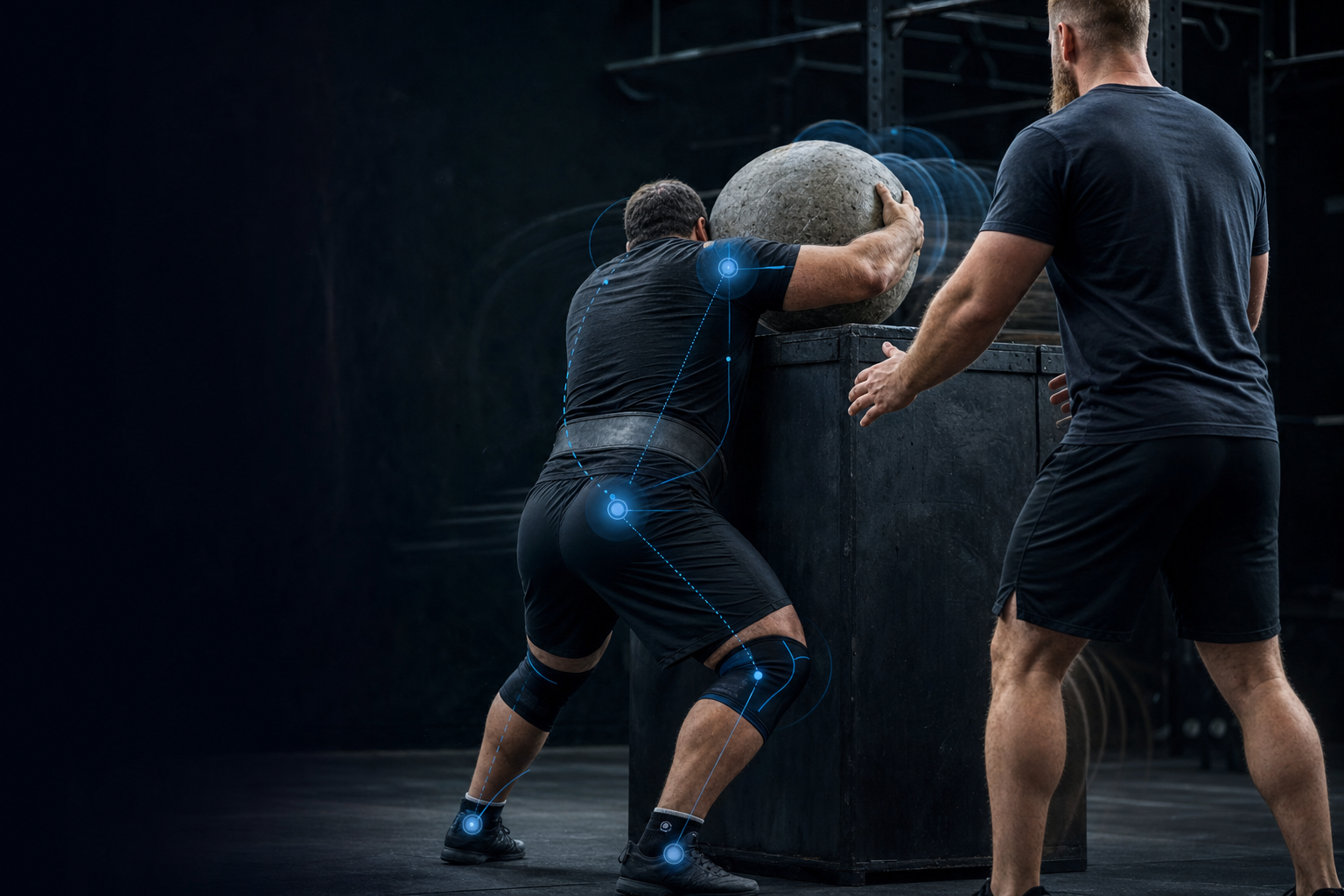
What a strongman coach actually does
A strongman coach designs and manages an athlete's training around strongman's specific implements and events, not just general strength work. That includes programming for the log press, atlas stones, yoke walk, farmer's carry, axle bar, and loaded odd objects, along with the technique each one demands. World Strongman's own coaching curriculum builds the job around four pillars: event-specific programming, technique, nutrition and recovery, and competition preparation.
A general strength and conditioning coach can get an athlete strong. A strongman coach also has to teach an athlete how to move a loaded stone onto a platform without tearing a bicep, and how to pace six events across two competition days instead of peaking for one lift. That is a narrower, more specialized job than general strength coaching, even though the two overlap heavily on the basics.
In the United States, most competitors will eventually run into Strongman Corporation, one of the country's largest organizations sanctioning and promoting amateur and professional strongman contests. A coach does not need any credential from that organization to work with an athlete. Its role is running and qualifying events, not certifying coaches. That is a meaningful difference from powerlifting, where the sanctioning federation and the coaching certification come from the same body.
Who typically becomes a strongman coach
Four kinds of people usually end up in this role. Competitors whose own competitive career is winding down, and who already know the implements from the inside. General strength and conditioning coaches who add strongman programming because hybrid athletes and CrossFit competitors keep asking for it. Gym owners who want a credentialed staff member to run a strongman class or team. And personal trainers whose clients start asking about stones and logs specifically and need programming beyond a standard hypertrophy template.
None of those paths is more legitimate than the others. What separates a good strongman coach from a bad one is usually the same thing regardless of background: whether they can actually coach the implements safely, adjust a program to whatever equipment an athlete has access to, and read fatigue accurately across a multi-event training week.
What makes it different from general strength coaching
Three things set strongman coaching apart.
The events rotate. A powerlifting meet is always the squat, the bench press, and the deadlift, the same three lifts every time. A strongman contest works differently. It publishes its own list of events beforehand, usually five or six, drawn from a pool that includes the log press, axle press, yoke walk, farmer's carry, atlas stones, tire flips, and various loaded carries. That list changes from meet to meet, so a coach has to program toward whatever the next show announces instead of a fixed lift pool.
Technique is implement-specific, not lift-specific. A log clean and press moves differently than an axle clean and press, mostly because of how the weight sits relative to the body. A coach who only knows barbell technique will under-coach the implement work that actually decides placings.
Training is not preparation for a separate event. For a competitive strongman athlete, training in the gym mirrors the competition floor directly. There is no separate game day that tests something different from what happens in training. That changes how a coach sequences a block heading into a meet. Peaking has to account for implement-specific skill, not only raw strength.
What a typical strongman training week looks like
Programs vary by coach, but most competitive strongman training weeks follow a similar shape. Two sessions built around barbell strength work: a squat-pattern day and a press-and-pull day, similar to what a powerlifter or general strength athlete would do. One or two dedicated event-training sessions, where the athlete practices the actual implements on the current program, log press, yoke, stones, whatever the next meet calls for. And one conditioning or general-preparation session, since several strongman events are decided as much by work capacity as by peak strength.
The closer a coach gets to a meet, the more the week shifts toward the specific implements and event order that meet will use, and away from generic barbell work. That taper is where a lot of the coaching judgment actually lives. Cutting volume too early leaves fitness on the table. Cutting it too late leaves an athlete fatigued on competition day.
Strongman coach certification: the WSM pathway
There is no single, universal license required to call yourself a strongman coach. The closest thing to an official credential comes from World Strongman International Union, the sport's governing body for its international competition structure. WSM runs a three-level coaching certification that its member federations recognize worldwide, with full curriculum details public for the National Instructor, Level 1, International Coach, Level 2, and Elite Coach, Level 3 courses.
| Level | Who it's for | What it covers | Cost |
|---|---|---|---|
| National Instructor (Level 1) | Coaches starting out with national-level strongman athletes | 14 lessons, about 12 hours: training principles, event-specific programming, nutrition, recovery, competition prep | €199 one-time, certificate valid 24 months |
| International Coach (Level 2) | Experienced coaches working with athletes at international competitions | 8 lessons, about 16 hours: advanced programming, competition strategy, technical compliance, anti-doping | €329 one-time, certificate valid 24 months |
| Elite Coach (Level 3) | Coaches working with world-class athletes at international championships | 6 lessons, about 20 hours: high-performance planning, injury risk mitigation, coaching leadership | €499 one-time, certificate valid 24 months |
Every level issues a WSM certificate with a QR code that verifies against the organization's public registry. Certified coaches appear in WSM's professional registry, which is what federations check when they need to confirm a credential is real instead of just claimed. The course pages do not state that Level 2 or Level 3 requires holding the level below it first, so read each course's own listing before assuming a strict prerequisite chain.
Cost and time, in plain numbers
WSM's three tiers run from €199 to €499, each a one-time payment with no separate membership fee required to enroll. Total course time ranges from about 12 hours at Level 1 to about 20 hours at Level 3, self-paced online. Certificates last 24 months before they need renewing.
That is a smaller time and money commitment than a credential like the CSCS, which requires a bachelor's degree before you can even sit for the exam. The next section breaks down that comparison directly.
Do you need a certification to coach strongman?
No governing body requires it. Strongman is a young, largely grassroots sport. A meaningful share of respected strongman coaches are former or current competitors who built their coaching knowledge through years of training and competing rather than through a course. Coaching someone else informally, the way an experienced training partner or gym owner often does, is common and not restricted.
What a certification actually buys a coach is structure and proof. WSM's curriculum forces a coach through material they might otherwise skip, like anti-doping rules and injury risk mitigation. It also gives a prospective client something to verify instead of taking a claim at face value. Treat certification as a credibility and structure decision, not a legal requirement.
WSM credential vs. general strength and conditioning certifications
A reader comparing paths is usually weighing WSM's sport-specific credential against a general certification like the CSCS or NASM-CPT. This is the same credentialing question we broke down for powerlifting coaches, and the shape of the answer is similar.
The CSCS requires a bachelor's degree and a current CPR/AED certification just to sit for the exam, and costs $340 for NSCA members or $475 for non-members. It is broad: program design, testing and evaluation, and sport psychology across any sport, not implement-specific strongman technique.
The NASM-CPT only requires a high school diploma or GED plus CPR/AED. The exam runs 120 questions over two hours, and a passing score is 70 or better. It is a general personal-training credential built for one-on-one client work, not sport-specific competition coaching.
Neither general certification touches strongman implement technique, event-specific programming, or competition rules. A coach who wants to work with competitive strongman athletes specifically gets more direct value from the WSM pathway. A coach who wants a broad, portable credential across any strength population gets more value from the CSCS or NASM-CPT. Some coaches eventually hold both: a general credential for program-design grounding, and the WSM certification for the sport-specific piece.
Coaching strongman without full equipment access
Not every gym has a yoke, a set of atlas stones, and a full run of log and axle bars. That is one of the most common practical problems in this sport, for coaches and athletes alike, and it is not a reason to avoid strongman training.
Most implements have a barbell or dumbbell substitute that trains the same pattern: trap-bar or barbell carries stand in for the farmer's carry and yoke, a thick-bar or axle substitute (even a fat grip attachment) can approximate log and axle pressing mechanics, and sandbag or keg loading can substitute for stones until an athlete has access to the real implement. A good coach builds the program around what is actually available, then schedules dedicated sessions at a strongman gym or local club to practice the real implements before a meet.
This is also where remote and online strongman coaching earns its place. A coach does not need to be standing next to the yoke to catch a technique flaw if they can review video of the set. It matters more that the coach sees the actual implement work than that they are physically present for it.
How to choose a strongman coach
If you are hiring rather than becoming one, the evaluation looks a lot like choosing any other strength coach, with one addition: ask how they would program around your next meet's actual event list, not a generic strongman template.
A few checks worth running before you commit:
- Ask what events they have coached athletes through specifically, not just strongman training in general.
- Ask whether they hold a WSM certification or have documented competition experience of their own. Neither guarantees quality, but WSM's registry gives you a way to verify a claimed credential instead of taking it on faith.
- Ask how they will adjust programming once your next meet's event list is announced. A rigid template that never changes is a warning sign in a sport where the events themselves change.
- Ask about their video review process. Implement technique is hard to correct from a description alone, so a coach who cannot review your lifts on video is limited in how much they can actually fix.
- Ask how they would program around your gym's actual equipment if you do not have full access to strongman implements.
Run that loop in Greater
Program each athlete's block around whatever events the next meet announces, get an AI first pass on their log press or stone-load video, and keep your coaching notes attached to the rep they're about. All in one place.
Try it freeIf you're hiring rather than becoming one, we broke down the same evaluation process for a related sport in how to choose an online powerlifting coach.
Frequently asked questions
What does a strongman coach do?
A strongman coach programs training around strongman-specific implements and events, like the log press, atlas stones, yoke, and farmer's carry, and manages competition preparation and pacing across multi-event contests. It is a narrower specialty than general strength and conditioning coaching.
Do you need a certification to be a strongman coach?
No. It is not a legal requirement, and many respected strongman coaches are experienced competitors with no formal credential. World Strongman's certification adds a structured curriculum and a verifiable registry listing, which matters more once you are coaching people other than yourself.
How much does strongman coach certification cost?
World Strongman's three tiers run €199 for National Instructor (Level 1), €329 for International Coach (Level 2), and €499 for Elite Coach (Level 3). Each is a one-time payment with a certificate valid for 24 months.
What's the difference between a strongman coach and a CSCS or NASM-certified trainer?
The CSCS and NASM-CPT are general strength and conditioning or personal-training credentials that apply across any population or sport. Neither covers strongman implement technique or event-specific programming. World Strongman's certification is built specifically around strongman's events and competition rules.
Can a powerlifting coach also coach strongman?
Sometimes. The raw-strength work overlaps, since both sports build around squatting, pulling, and pressing patterns. But strongman's implement technique, event variety, and competition pacing are different enough that experience in one sport does not automatically transfer to competence coaching the other.
How do you find a good strongman coach?
Ask what specific events they have coached athletes through, whether they hold a WSM certification or have documented competition experience, and how they would adjust your programming once your next meet's event list is announced. A coach who cannot describe how they would review your implement technique on video is a limiting choice.