

Online Powerlifting Coach: How to Choose One (And Whether You Need One)
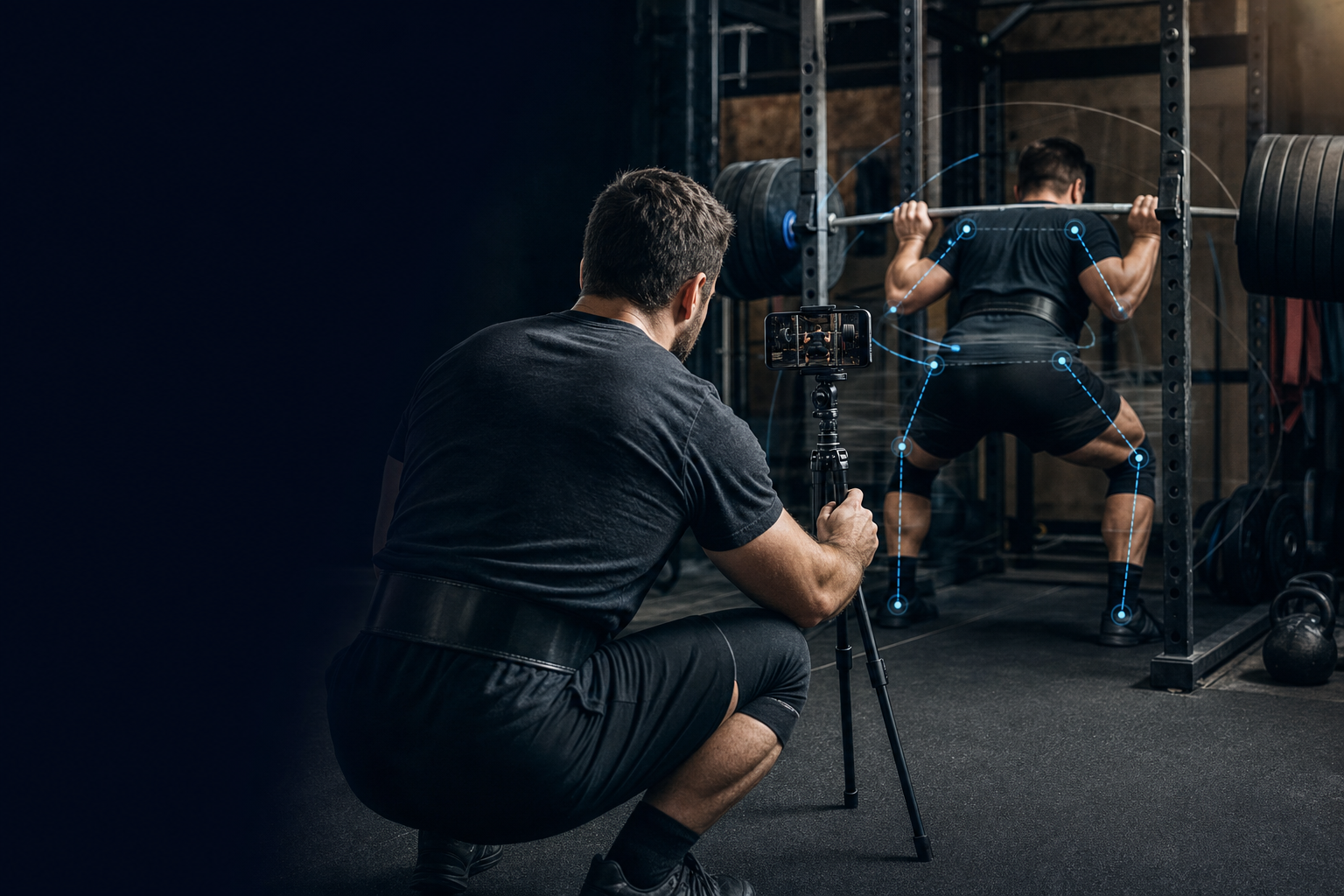
Search “online powerlifting coach” and the results are mostly Reddit threads and a handful of coaching businesses selling their own programs. Nobody breaks down what you are actually paying for, what separates a powerlifting-specific coach from a general trainer, or how to tell a good one from a bad one before you commit to a month of payments. This guide does that, with the questions to ask before you sign up and the research behind why meet-day coaching is its own skill.
What an online powerlifting coach actually is
An online powerlifting coach programs your squat, bench press, and deadlift training remotely, reviews video of your working sets, and builds your training around a specific competition date. That is a narrower job than general online strength coaching. A strength coach optimizes general strength or muscle gain for whatever goal you bring. A powerlifting coach optimizes one number, your total, for one day: your next meet.
That distinction matters more than it sounds like it should. A generalist can write you a solid squat, bench, and deadlift program. A powerlifting-specific coach also knows how depth gets judged, what a legal bench command looks like, which gear is allowed in your federation, and how to plan the six weeks before a meet instead of an open-ended training block.
It also matters for who the coach is watching you become. A strength coach's job is done when you are stronger. A powerlifting coach's job is done when you stand on the platform with a plan for three attempts, not just a heavier gym max than you had in January.
The keyword itself gets used loosely online. Some people search it wanting a coach for the sport specifically. Others are really looking for a general strength coach who happens to know powerlifting terminology. It's worth deciding which one you actually need before you start reading coach bios, since the sales pages rarely make the distinction for you.
What the coaching relationship actually looks like week to week
The loop is the same across almost every online powerlifting coach worth paying. You get a program for the week. You train, and you film your working sets on the three competition lifts specifically, not just whatever exercise you feel like recording. Your coach watches the video, checks it against your technical standards, and writes next week based on what actually showed up on the bar, not just what the spreadsheet predicted.
That program still rests on the same fundamentals as any powerlifting training, like how you structure your training week, a coach just adjusts that structure around you specifically instead of leaving it fixed for a whole training cycle.
A good coach also wants more than the video. How heavy each working set felt, whether you slept and ate normally that week, and anything nagging in a joint all change how the next week gets written. A lifter who sends a clean squat video and nothing else is giving a coach half the picture. The video shows what happened. The rest of the report explains why.
That loop is what makes it coaching instead of a subscription to a PDF. A static template cannot watch your squat get grindier at a fixed percentage and pull next week's volume back before it turns into a missed rep. A coach can. Software on its own does not close that gap either. It will hold the program and the footage, then wait for a human to decide what the footage means.
Closer to a meet, that same weekly loop is also how a coach builds your meet-prep taper, tightening volume and holding intensity in the final weeks so you show up strong instead of just tired.
What a powerlifting-specific coach adds that a general template can't
General research on coached versus self-coached strength training favors having a coach, and we cover that evidence in full in our guide to online strength coaching. What's specific to competitive powerlifting is not just whether a coach helps you train. It's whether they can help you compete.
Meet-day strategy is a real, researched skill, not a coin flip. A large analysis of competition results from Australian powerlifting meets found that lifters who won opened with meaningfully heavier first attempts than the lifters who didn't. Across more than 10,000 competition entries, women who won opened about 10 to 11 kilograms heavier than non-winners on both squat and deadlift, and about 6 kilograms heavier on bench press. Men who won opened 16 to 17 kilograms heavier on squat and deadlift, and about 11 kilograms heavier on bench press.
Picking that opener wrong cuts both ways. Too heavy and you risk missing your best lift of the day. Too light and you leave your total on the table before the meet even gets hard. That call, and the second and third attempt jumps that follow it, is exactly the kind of judgment a coach who has stood in a hundred warm-up rooms makes better than a first-timer guessing alone.
Credentials and certification to look for
A general personal-training certification doesn't cover any of this. Powerlifting has its own federation-run coaching path. In the US, USA Powerlifting certifies coaches at three levels: Club Coach, National Coach, and International Coach, each building on technical-rules knowledge and meet-management experience.
Club Coach covers the basics: anatomy and biomechanics, the rules of performance for squat, bench, and deadlift, and the fundamentals of meet preparation. National Coach adds team and meet management on top of that. International Coach requires having already served as an assistant coach for a national team competing abroad.
None of this is required to call yourself an online powerlifting coach. That's exactly why it's worth asking about directly. Certification is one signal, not a guarantee, and it works alongside the questions in the vetting checklist below, not instead of them.
If you haven't already settled on a federation and weight class, do that first. A coach can't plan meet-specific technical rules or attempt strategy around a federation you haven't chosen yet.
Track record is worth as much as the certificate itself. Ask how many lifters a coach has taken to a meet, not just how many people they currently program for. Coaching someone through a normal training block and coaching them through fatigue management, weigh-ins, and attempt selection in the same week are different skills, and only one of them shows up on a certification.
How far out from a meet should you hire a coach?
The honest answer is the earlier the better, with a practical minimum. Hiring a coach 10 to 12 weeks out gives them time to run a real training block, see how you respond to it, and build a taper around your actual numbers instead of guessing from a first video. Hiring a coach in the final two or three weeks before a meet mostly buys you attempt selection and warm-up planning. That still has real value on the day, but it skips the part of coaching that raises your total instead of just deciding how you spend it.
If you're not ready to commit to a full training block, that short pre-meet window is also a reasonable way to trial a coach's communication style and video-review turnaround before handing them the next several months.
DIY template vs. general online trainer vs. specialized powerlifting coach
Not everyone needs the same level of coaching. Here is how the three real options compare.
| Option | Programming specificity | Technique review | Meet-day support | Best for |
|---|---|---|---|---|
| Free or paid template | Fixed. Does not adjust to how your training actually goes | None | None | A first training block, on a tight budget, with no meet booked yet |
| General online strength coach | Adjusted to you, but not powerlifting-specific | General form checks | Limited or none | General strength goals, no competition date in mind yet |
| Specialized online powerlifting coach | Adjusted to you and your competition date | Squat, bench, and deadlift specific, federation-aware | Attempt selection and warm-up planning | Anyone with a meet on the calendar |
The further right you move on that table, the more you're paying for judgment, not just a spreadsheet.
Questions to ask before you hire a coach
Ask these before you pay for a first month, not after.
| Ask this | What a good answer sounds like |
|---|---|
| What's your certification and federation experience? | A specific level and federation named, not just “certified” |
| How often will you review my video, and what's the turnaround? | A specific number of days, not “quickly” or “as soon as I can” |
| Have you coached lifters at a meet in my federation? | A real meet they can name, not only online-only experience |
| How does attempt selection work on meet day? | A described process, warm-up timing and opener logic, not a vague “we'll figure it out” |
| How do we communicate, and what is your response time? | A named channel and a realistic window, not “anytime” |
| Is there a trial period before I commit long-term? | A month-to-month option or a short trial, not a forced multi-month lock-in |
Red flags
A few patterns are worth walking away from. A coach who promises a specific total gain by a specific date, since strength is not that predictable and nobody can guarantee it. A coach who never asks to see your video, because programming without technique review is just a subscription to a spreadsheet with extra steps. A program that looks identical to the one your training partner got, when a real coach adjusts for your leverages, your weak points, and how your last block actually went. A coach with no meet-day plan, since that is a real part of what you are paying for. Pressure to sign up for six months before you have had a single week to see how the video review actually works.
None of these are automatically disqualifying on their own, and a good coach can have an off week like anyone else. What matters is the pattern. One vague answer is worth a follow-up question. Several of them in a row, especially paired with pressure to commit before you have seen a single week of feedback, is worth taking your money elsewhere.
What it costs
There's no single reliable number to quote here, and any guide that gives you one is guessing. Price varies with a coach's experience, their federation-specific expertise, and how much individualized video review is actually included versus a templated program with a coach's name attached to it.
Ask what's included before you compare price between two coaches. Programming alone, with no video review, costs less than programming plus a real weekly video-review loop and meet-day support. Two coaches quoting the same monthly rate can be selling very different things.
As a rough shape: a coach splitting review time across many lifters on a shared template tends to sit at the lower end. A coach doing individual weekly video review and direct meet-day involvement for a small roster sits at the higher end. Ask which one you are actually being quoted before you compare two numbers side by side.
What good remote coaching tools look like
The coaching relationship lives or dies on the video-review loop. You submit a lift, your coach gives feedback tied to that specific rep, and you see the adjustment show up in the next session. That is true no matter what software a coach uses to run it.
Greater is built around exactly that loop for coaches running powerlifting-specific programs, built to remove the friction between a lifter's rep and a coach's next call.
Coaching powerlifters remotely?
Greater Form gives you an automated read on a lifter's technique and a Safety Score on the sets you send through it, so your review time goes to coaching instead of scrubbing through a camera roll.
Try it freeA good online powerlifting coach is not a luxury add-on to a program you could have written yourself. It's a second set of trained eyes on your technique and a second brain on your meet-day math. Ask the questions above before you pay for either.
Frequently asked questions
Is an online powerlifting coach worth it?
For most lifters with a meet on the calendar, yes, if the coach actually runs a real video-review loop and adjusts your plan around it. A coach who hands you a template and never watches your lifts is not delivering what makes coaching worth paying for in the first place. The value shows up most clearly in the weeks before a meet, when programming, technique, and attempt strategy all have to line up at once.
How much does an online powerlifting coach cost?
Pricing varies too widely by experience and what's included to quote a single reliable number. Ask exactly what you get, programming, video review, and meet-day support, before comparing price between coaches.
What is the difference between an online powerlifting coach and an online strength coach?
A strength coach optimizes general strength or muscle gain for any goal you bring. A powerlifting coach optimizes your total for a specific competition date, under your federation's technical rules, and plans your attempts on meet day.
Do I need to already be advanced before I hire a powerlifting coach?
No. A first meet is one of the better times to hire one. You get a federation's technical rules explained before you build habits around the wrong ones, plus someone else doing the attempt math on a day that is already overwhelming. Ask whether the coach has taken first-timers to a platform, not just experienced lifters.
Can an online coach really help with attempt selection if they aren't at the meet?
Yes, if they build a warm-up and attempt plan with you in advance and stay reachable by message on the day itself. Most competitive powerlifting coaching, online or in-person, happens in the weeks before a meet, not standing at the platform.
How fast should a powerlifting coach turn around video of my competition lifts?
Fast enough that the feedback lands before your next session on that lift. In a typical week that means a day or two on squat, bench, and deadlift work. Ask for a number before you hire someone. If feedback on your heaviest set arrives after you have already trained the lift again, it cannot change anything you do.