

Soccer Leg Workout: The Session That Actually Builds Soccer Legs
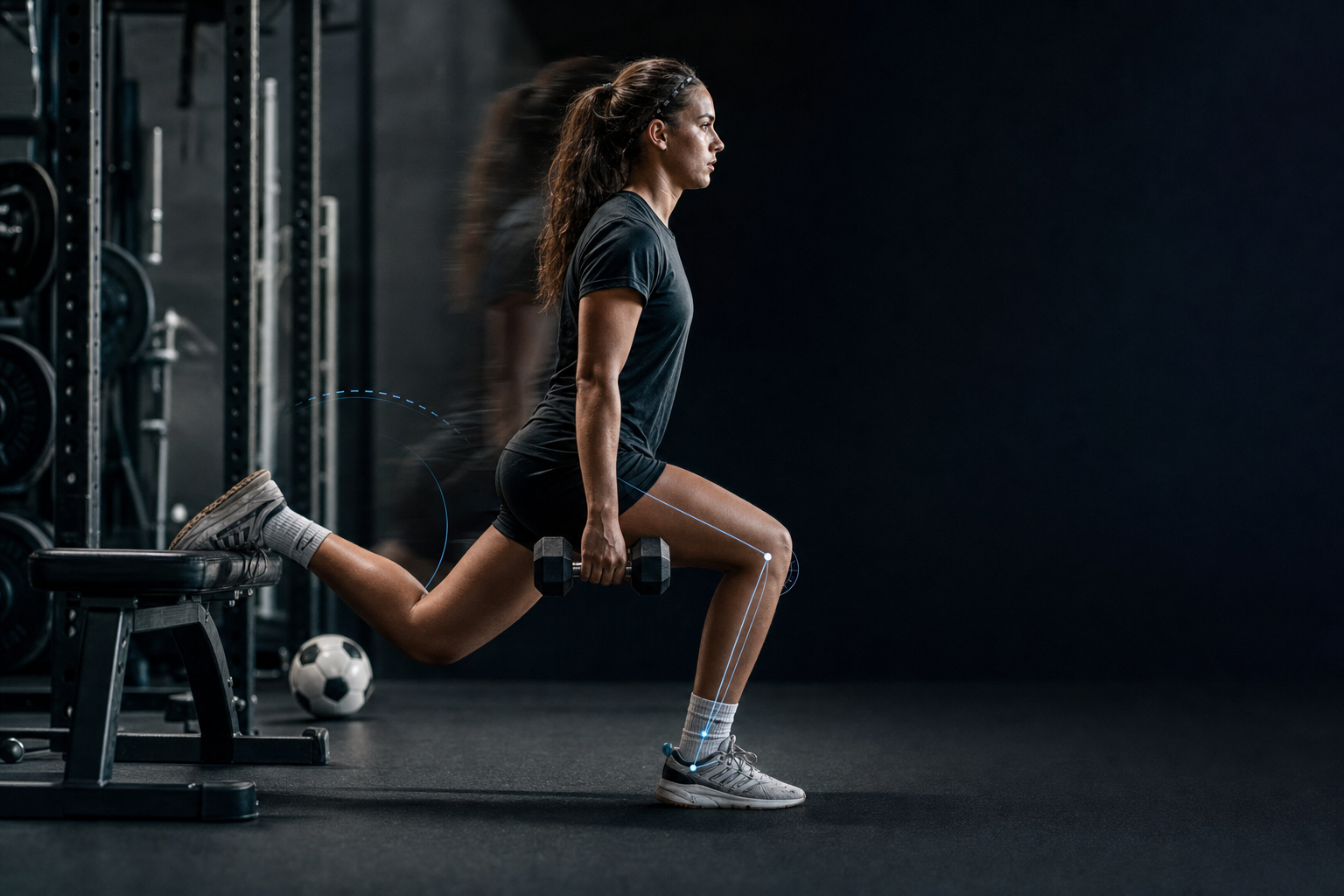
Search for a soccer leg workout and you get a leg day. Barbell squats, leg press, walking lunges, calf raises. Three sets of ten to failure. Walk out sore and call it a session.
That workout was designed for a different sport. Soccer's own injury data says so. Across nine years of men's professional football, muscle injuries made up 31% of all time-loss injuries, and 92% of them landed on four muscle groups in the lower limb. The hamstrings took 37% of them. The adductors took 23%. Those two groups account for six of every ten muscle injuries in the sport, and a squat-and-lunge leg day trains neither one the way it fails.
This article gives you the session that covers the whole job. You get a full lower-body workout with sets, reps and loads. You get a weekly layout for in-season and offseason. You get the dosage for the two exercises most players skip. And you get three cheap tests to check whether eight weeks of work changed anything.
What a soccer leg workout should actually do
A soccer leg workout is a lower-body session built around five jobs: maximal two-legged strength, single-leg strength, eccentric hamstring work, adductor work, and a small dose of jumping or sprinting. It runs twice a week. It takes 45 to 55 minutes. It is scheduled around your match, not around how sore you want to be.
The difference from a bodybuilding leg day is the goal. A leg day is trying to grow muscle. A soccer leg session is trying to make you quicker over ten meters, sharper coming out of a cut, and better able to hold that in the 80th minute. Those goals want different exercises, different rep ranges, and a very different place in the week.
Why the standard leg day misses
The muscle injury numbers come from a nine-year study of 51 professional clubs and 2,299 players. Across 2,908 muscle injuries the split was hamstrings 37%, adductors 23%, quadriceps 19%, calves 13%. Sixteen percent were reinjuries, and the reinjuries cost significantly more time than the originals.
Now read that split against a normal leg day. Squats and leg press load the quadriceps hard, which is the 19%. Lunges add a little. Nothing in the session loads the hamstrings while they lengthen. Nothing at all loads the adductors. The workout is well aimed at the third-biggest problem and blind to the two biggest.
The leg press is the clearest example. It is comfortable, it lets you load a lot of weight, and it holds your back and hips in place while you do it. Soccer never holds your hips in place. Every acceleration, cut and landing asks one leg to control the trunk above it while the other one is in the air. A machine that removes that demand is not a bad exercise. It is just not the one this sport is asking for.
This is not an argument against squatting. Squatting stays. It is an argument for a session with more than one job in it. If you want the deeper version of the hamstring side of this, we covered what the evidence supports for hamstring strain risk separately.
The five jobs of a soccer leg session
Job one is maximal strength. In elite male players, maximal half-squat strength tracked closely with both sprint times and vertical jump height. Strength is not the whole picture. It is the base the rest of it sits on.
Job two is single-leg strength. Soccer is played on one leg at a time, so the temptation is to make the whole session single-leg. The evidence says be careful with that. An 18-week trial matched training volume between a bilateral group and a unilateral group. Both improved maximal strength and 20 m sprint, with no clear difference between them. The bilateral group improved change of direction more. Keep the heavy two-legged lift at the center. Use single-leg work to close the gaps between your left and right side, not to replace the barbell.
Job three is eccentric hamstring work. Job four is adductor work. Both get their own section below, because both are the ones players quietly drop.
Job five is a small dose of jumping or sprinting. A review of twelve studies in female soccer players compared strength training with plyometric training. Plyometric work came out ahead of strength work on vertical jump, linear sprint and change of direction, with small to moderate effect sizes. The authors were direct about the limits in the literature, so treat this as a reason to put jumps in the session rather than a reason to build the session around them.
The soccer leg workout
Run this twice a week. The order matters. Jumps go early while you are fresh, the main lift goes second, and the injury-resistance work goes late where fatigue does not ruin it.
| Exercise | Sets and reps | Load or tempo | Job it does | Coaching cue |
|---|---|---|---|---|
| Broad jump | 3 x 3 | Bodyweight, full rest | Horizontal power | Stick the landing for a full second before the next rep. |
| Lateral bound | 3 x 3 each side | Bodyweight, full rest | Cutting power | Push sideways off the outside foot, do not just hop. |
| Trap bar deadlift or back squat | 4 x 4 to 6 | Heavy. Leave two reps in reserve | Maximal strength | Same bar speed on the last rep as the first. If it slows, stop the set. |
| Romanian deadlift | 3 x 6 to 8 | Moderate, three seconds lowering | Hamstring strength under length | Push the hips back, keep the bar against the legs. |
| Rear-foot-elevated split squat | 3 x 8 each side | Dumbbells, controlled | Single-leg strength, side-to-side balance | Start with the weaker leg and match the stronger leg to it. |
| Nordic hamstring curl | 3 x 5 to 8, see progression | Bodyweight, slow lowering | Eccentric hamstring strength | Fight the whole way down. Catch yourself with your hands. |
| Copenhagen adduction | 3 x 6 each side | Bodyweight, level 1 to 3 | Adductor strength | Short lever first. Only lengthen it when 6 reps are clean. |
| Single-leg calf raise | 3 x 12 each side | Bodyweight or dumbbell, full range | Calf and ankle stiffness | Pause at the top, lower all the way down. |
| Single-leg balance with ball touches | 2 x 30 seconds each side | Bodyweight | Ankle and foot control | Soft knee, quiet foot, eyes off the floor. |
That is 45 to 55 minutes with normal rest. On a compressed week, cut it to the jumps, the main lift at two sets, the Nordics and the Copenhagens. That version takes 25 minutes and keeps the parts that matter most.
No barbell? Swap the trap bar deadlift for a heavy goblet squat or a dumbbell split squat at low reps, and the Romanian deadlift for a single-leg Romanian deadlift with two dumbbells. The Nordic curl, the Copenhagen and both jumps need no equipment at all.
Where the session fits in your week
Two rules decide this. Heavy leg work goes early in the week, and nothing heavy goes inside 48 hours of a match. Break either one and the session starts costing you on the pitch instead of paying you.
| Day | In-season (Saturday match) | Offseason | Note |
|---|---|---|---|
| Monday | Recovery or light technical | Full leg session | In-season Monday is for getting the match out of your legs. |
| Tuesday | Full leg session after training | Pitch work: passing, small-sided | Furthest point from the match. This is your heavy day. |
| Wednesday | Team training | Sprint day plus Copenhagens | Offseason sprint day is short. Six to eight hard runs, full rest. Nordics stay on the two full leg days. |
| Thursday | Short session: jumps, main lift at two sets, Nordics, Copenhagens | Full leg session | In-season Thursday is 25 minutes, no grinding sets. |
| Friday | Activation and 11+ warm-up only | Light technical or off | Nothing that leaves you sore. |
| Saturday | Match | Optional pickup or rest | Match day. |
| Sunday | Off or easy movement | Off | Take it. |
Two matches in a week changes the plan. Cut the full session entirely and run the short one on the day between, jumps included but the main lift dropped. Keep the Nordics and Copenhagens in both weeks no matter how congested the fixture list gets. They cost the least fatigue of anything in the session, and they are always the first things a busy week deletes.
If you coach a squad rather than train yourself, the same layout scales, and the harder problem becomes knowing who actually did the Thursday session. We build Greater around soccer programs for exactly that reason. For the full week including upper body and conditioning, we published a complete weekly strength and conditioning template you can drop this session into.
The two exercises to never drop
The Nordic hamstring curl is the first. An umbrella review pooled ten systematic reviews covering 125 studies and more than 17,000 people. It found lower hamstring injury rates in groups doing Nordic work, alongside better sprint performance, higher eccentric strength and longer muscle fascicles. The dosing recommendation was a high-volume build followed by low-volume maintenance, in the region of 48 reps per week.
Be honest about the spread. That same umbrella review opens by noting there are still doubts about the exercise's benefits and risks. What is not in dispute is that it builds eccentric hamstring strength, and that eccentric hamstring strength is the quality the sport keeps breaking. Do them. Do not expect a guarantee. If you want a build-up that works for a whole squad, we wrote a ten-week Nordic progression for teams.
The Copenhagen adduction is the second, and it is the cheapest item on this page. A cluster-randomised trial ran 35 semi-professional teams and 652 players through a single-exercise adductor programme: three times a week through a six to eight week preseason, then once a week through the season. Average in-season prevalence of groin problems was 13.5% in the group doing it and 21.3% in the group that did not, and the risk of reporting a groin problem was 41% lower.
One exercise, once a week in-season in the trial, for a meaningful drop in groin problems. Those sit on the second most injured muscle group in the sport. None of this eliminates risk. It lowers it. Pain that persists is a different matter, and that goes to a physical therapist or physician rather than getting trained through.
Warm up like the session counts
Warm-ups are where most players lose the free wins. A meta-analysis pooled six cluster-randomised trials of the FIFA injury prevention programmes. The four studies using the 11+ showed a 39% reduction in overall injuries, in recreational and subelite football. The two studies using the older 11 programme showed none.
Same idea, different execution, completely different outcome. The version matters, and so does actually running all of it rather than the first two exercises. The 11+ is also one of the structured neuromuscular warm-ups used to lower knee injury risk, so it is doing more than one job before you touch a barbell.
Progressing it over eight weeks
Weeks 1 and 2 are for learning positions and writing down loads. Use the low end of every rep range on the main lift. Keep the Nordic at three sets of five, twice a week. That is 30 reps across the week. Expect to be sore for a few days after the first one, and do not add a third session to chase that feeling.
Weeks 3 to 5 are the build. Add weight to the main lift when the last rep of the last set still moves like the first one. Push the Nordic to three sets of eight, twice a week. That is 48 reps across the week, which is the dose the evidence points at. Keep jump volume flat while you do it.
Weeks 6 to 8 are the sharpening block. Drop the main lift to two hard sets and keep the load. Move the jumps to the very front of the session while your legs are fresh. Cut the Nordic to three sets of five once a week, which is 15 reps of maintenance. Keep it in the Tuesday session and drop it from the Thursday one. You should finish this block feeling faster, not more tired.
Two rules govern all of it. Add load only when bar speed holds on the last rep. Never add jump volume and lifting load in the same week.
At the end of week 8, take an easy week. Halve every set count, keep the movements, and do not test in it. Then start the next block from the loads you finished on.
How to know it is working
Three tests, all free, all repeatable in 15 minutes. A 10 m sprint from a standing start. A countermovement jump measured by reach against a wall. A single-leg hop for distance on each leg, compared side to side.
Run them the same way every time or the numbers are worthless. Same warm-up, same surface, same shoes, same time of day, and never the day after a match. Take the best of three attempts on each. Write the numbers down somewhere you will still have them in eight weeks.
Test in the first week of a block and the last week. Not weekly. Week-to-week noise will tell you nothing except how you slept. What you are looking for over eight weeks is a faster 10 m, a higher jump, and a smaller gap between your left and right hop.
The side-to-side hop gap is the one most players ignore and the one this session is built to close. If one leg travels noticeably further than the other, the shorter side is the one to work on. The split squat and Copenhagen sets are where you do that. Start every set with the weaker side and give the stronger side the same number of reps, not more. A gap that will not close across a block, or one that comes with pain, is worth a look from a physical therapist.
The honest part is this. The session that gets run beats the better session that does not. Two players with the same program eight weeks later look nothing alike, and the difference is almost never the program. It is how many of the 16 sessions actually happened. Whether you are tracking one player or a full squad, the thing worth logging is completion first and numbers second.
Run the session, not just the plan
Assign the workout to a player or a full roster, see who completed each session, and track sprint and jump numbers across the block.
Try Greater freeCommon mistakes
Training to failure the day before a match. Soreness is not fitness, and it costs you a step in the first 20 minutes.
Treating the Nordic curl as optional. It is the one exercise in the session aimed straight at the most common muscle injury in the sport.
Going all single-leg. Split squats and step-ups are useful, but they do not replace a heavy two-legged lift, and change of direction is where that shows up.
Adding jump volume during a fixture-congested week. Jumps and matches draw on the same account.
Skipping calves and feet. Thirteen percent of soccer's muscle injuries are calf injuries, and the calf raise is the least glamorous 90 seconds in the session.
The single-leg and jump work in this session builds the same qualities a vertical jump depends on. Our vertical jump program takes that further with a dedicated 10-week plan.
Frequently asked questions
How often should soccer players train legs?
Twice a week is the target, in-season and off. In-season, the first session is the full workout placed as far from the match as possible, and the second is a 25-minute power session. Once a week maintains what you have. Three times a week is usually too much on top of team training and matches.
Will lifting make me slow or bulky?
No, if the reps stay low and the loads stay heavy. Heavy, low-rep lifting tracks with faster sprint times and higher jumps in elite players, which is the opposite of slow. Bulk comes from high-rep, high-volume, near-failure training paired with a large calorie surplus, none of which is in this session.
Can I do this without a gym?
Most of it, yes. The Nordic hamstring curl, the Copenhagen adduction, both jumps, the calf raise and the balance work need nothing. Swap the trap bar deadlift for a heavy goblet squat or a low-rep dumbbell split squat, and the Romanian deadlift for a single-leg version with dumbbells. You lose some of the maximal strength stimulus, and you keep everything else.
Should I train legs the day before a game?
Not heavy. Keep nothing demanding inside 48 hours of kickoff. The day before a match is for a full warm-up, some light activation and short sharp movement, and nothing that leaves you sore.
Do I still need this in-season?
Yes, and in-season is where most players quietly stop. Team training and matches build match fitness, not maximal strength or eccentric hamstring strength, and both fade without direct work. Two short sessions a week is enough to hold them.
What about youth players?
Same five jobs, lighter loads, more coaching on positions. Younger players get a lot from bodyweight and dumbbell versions before they need a heavy barbell. Progress the Nordic and Copenhagen slowly, because both are demanding the first few weeks, and get a qualified coach to watch the lifts.