

Landing Mechanics: What a Phone Video Can Actually Tell You
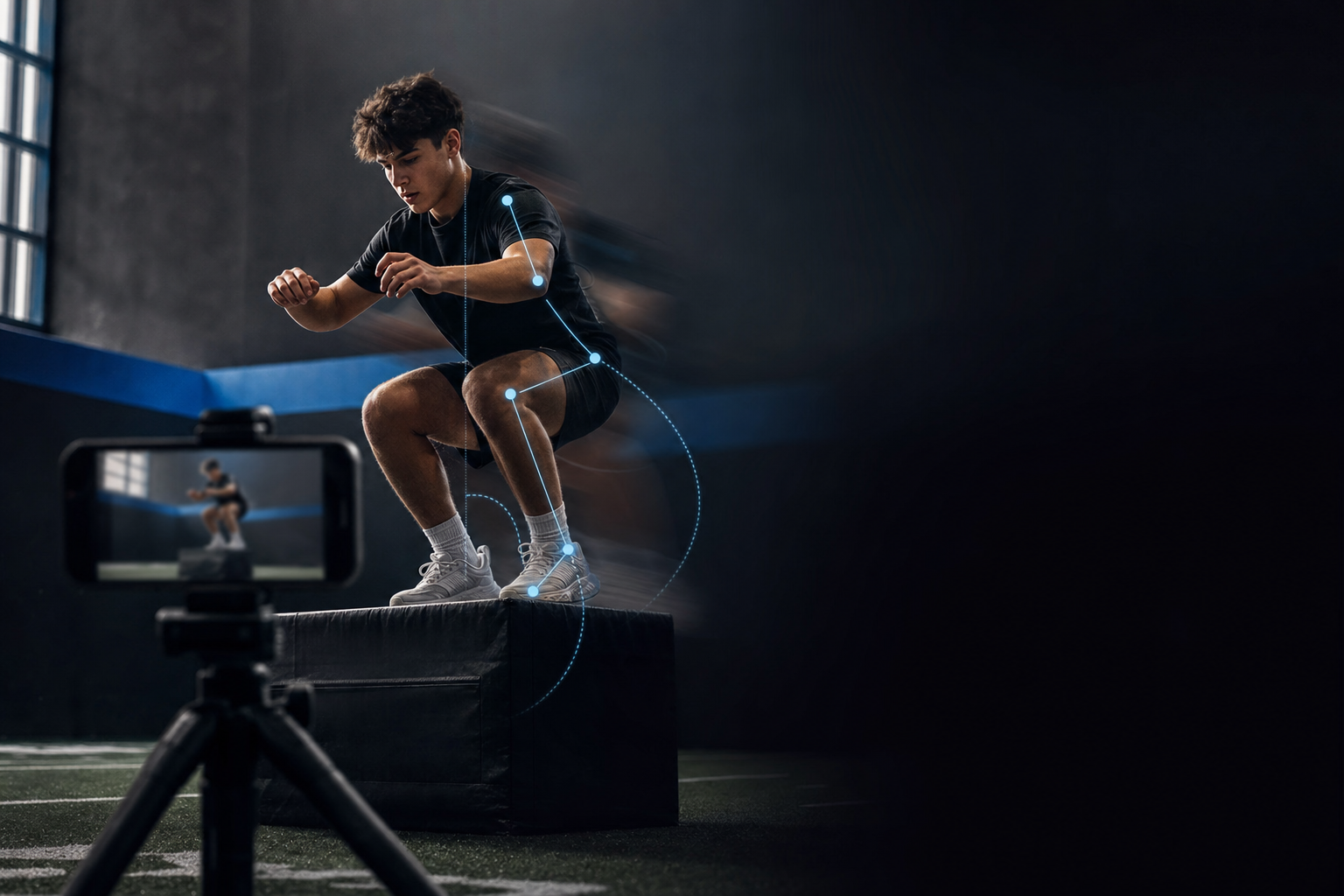
Landing mechanics is how an athlete absorbs force on the way down. Not how high they got. How they handle the floor when they arrive.
Coaches care about it for one reason. The knee position linked to higher non-contact knee injury risk is visible on video, and it is coachable.
Here is the honest version of what that video gives you. A phone is good enough to decide what to coach. It is not good enough to decide who is going to get hurt. Those are two very different claims, and most of what you will read online blurs them together. This piece keeps them apart. If you want the takeoff side of the equation instead, that is a separate performance question.
What landing mechanics actually means
Landing mechanics is the pattern an athlete uses to absorb force when they come down from a jump, a hop, or a cut. Good mechanics means the hips, knees and ankles all bend to share the load, and the knee stays tracking over the foot. Poor mechanics means a stiff landing, or a knee that collapses inward toward the other leg.
That inward collapse is the one worth knowing by name. You will see it called knee valgus, dynamic valgus, or just medial knee collapse. On video it looks like the kneecap drifting across toward the midline while the foot stays put.
It matters because of what happened in a study that screened athletes before their seasons and then waited. The athletes who went on to sustain an ACL injury had already shown larger inward knee angles and larger inward knee loading when they landed from a drop jump, measured before the injury happened.
Read that carefully. It is an association found in one cohort, not a verdict on any individual. Landing like that is linked to higher risk. It does not mean an athlete will get hurt, and landing well does not mean they will not.
Why coaches look at the landing and not the jump
The takeoff is a performance measure. It tells you how much force an athlete can produce.
The landing is a different question. It tells you what position the knee is in while it absorbs force. That is the position linked to higher non-contact knee injury risk. The two are worth tracking separately. A jump program raises the ceiling. A landing screen tells you whether the athlete can come back down safely from it.
How to film it
You need a phone and five minutes. Camera quality is not the limiting factor. Consistency is.
- Prop the phone on a tripod, a bench, or a cone stack. Lens at roughly knee height, not eye height. Shooting down at an athlete distorts the angles you are trying to judge.
- Film two angles. One from directly in front, athlete square to the camera. One from the side.
- Stand about ten feet back so the whole body stays in frame through the landing.
- Use 60 frames per second if your phone offers it. The landing is over in a fraction of a second.
- Film two or three reps, not one. First reps are often tidier than real ones.
- Keep filming through the second contact. Plenty of athletes land well and then collapse on the rebound.
- Write down where the camera was. Next time, put it back there.
That last point is the one people skip, and it is the one that makes the screen useful. The comparison that matters is this athlete against themselves, eight weeks later. That comparison only holds if the camera has not moved.
Film the clips once and keep them somewhere you can find them. Greater lets you collect an athlete's video in one place and run AI analysis on the movement, so the preseason clip and the mid-season clip sit side by side instead of scattered across a camera roll.
The drop vertical jump, and the score coaches use
The standard task is the drop vertical jump. Step off a low box, around 12 inches. Land on both feet. Immediately jump straight up as high as you can.
It is a good test task for a practical reason. The athlete is thinking about the jump, not the landing, so you see their default pattern rather than their best behavior.
For scoring, the established tool is the Landing Error Scoring System. You watch the two camera angles and tally technique errors. Higher score means more errors. It has been shown to be a valid and reliable clinical assessment of jump-landing biomechanics, which is why it turns up in research and in clinics rather than coaches inventing their own tally every time.
You do not need the formal version to get value out of this. What follows is the short list of faults that account for most of what you will actually see on a gym floor.
The five faults worth coaching
Work through the clip once per fault rather than trying to catch all five at once. Front view for the first, side view for the next three, either view for the last.
| What you see on the video | Why it matters | The cue that fixes it |
|---|---|---|
| The knee drifts inward, past the line of the big toe, as the foot lands | This is the inward knee collapse linked to higher non-contact knee injury risk | Put two cones just outside the feet. "Land with your kneecaps pointed at the cones." |
| Legs stay almost straight. Very little knee or hip bend on contact | Force gets absorbed by the joint and the ligaments instead of the muscles | "Land quiet. Sink into the floor, do not stop on top of it." |
| Trunk stays upright or leans back, hips end up behind the heels | Takes the glutes and hamstrings out of the landing, leaving the quadriceps and the knee to do it | "Reach your chest out over your toes as you come down." |
| Flat-footed or heel-first landing, with an audible slap | The ankle contributes nothing, so the knee takes load earlier and harder | "Toes down first, then heels, then sink." |
| Clearly more weight on one leg, or a visible sideways shift on contact | Asymmetry under load. Often a leftover from an earlier injury the athlete has stopped mentioning | Do not coach this one. If the shift is marked, or there is any pain, swelling, instability or giving way, send the athlete to a physical therapist or physician. |
Notice that every coaching cue in that table points at something outside the body. A cone, the floor, a direction to reach. That is deliberate.
Cues that aim an athlete at an external target tend to change movement more effectively than cues about body parts. "Point your knees at the cones" works better than "do not let your knees cave in." Same fault, different instruction, better result.
One more practical note. Do not read the score out to the athlete. Give them one fault and one cue, let them run three more reps, and film again. Five corrections at once produces a worse landing than none.
What a phone video cannot tell you
This is the part the rest of the internet leaves out, and it is the part that decides how you should use the screen.
First, a 2D camera reads some joints much better than others. Compared against laboratory motion capture on the same landings, 2D video agreed strongly with the lab on hip adduction, with correlations in the range of 0.70 to 0.90. On inward knee angle it agreed weakly, in the range of 0.17 to 0.42. So your front-view judgment about the hip is fairly trustworthy. Your judgment about exactly how far the knee collapsed inward is not.
Second, the flat-camera knee angle does track the knee loading that actually matters, but loosely. A study that tested this directly found the angle predicted frontal-plane knee moments during landing and change of direction, and described the predictive ability as weak to moderate.
Third, and most important: a landing score comes nowhere near identifying the individual athlete who is going to get injured. Researchers screened 829 elite-youth soccer athletes and followed them across 1,217 athlete-seasons. The athletes who went on to tear an ACL had scored worse on the landing screen beforehand, and on that basis the researchers describe the tool as showing potential. But look at what the estimate rests on. Seven ACL injuries occurred across all 1,217 athlete-seasons. Seven. The authors name the sample size as a limitation themselves. The error threshold they identified also flagged roughly a third of the athletes who never got hurt.
A much smaller group of Division I athletes points the same way. There, landing scores did not separate the groups at all, either between athletes with a prior lower-body injury and athletes without one, or between the athletes who got hurt that season and the ones who stayed healthy.
None of that makes the screen worthless. It makes it a different kind of tool than people assume. A measure can be good at telling a squad apart on average and still be far too blunt to call an individual.
Because here is what the method does do well. 2D video assessment of inward knee collapse during common screening tasks is reliable within a day and between days, as long as the task and the camera stay the same. Repeatable measurement of change is exactly what coaching needs.
So use the screen to decide what to coach. Do not use it to decide who is at risk. A coach films a squad and finds eleven stiff-legged landings. Building that into the warm-up is the correct use. Telling one athlete their score means they are likely to tear an ACL is not. The research does not support saying it.
If you want the wider picture of which knee injuries respond to training and which do not, that is covered injury type by injury type elsewhere on this blog.
What to actually do about a bad landing
A screen is only worth running if something happens afterwards. The good news is that the thing which happens afterwards has real evidence behind it.
Neuromuscular training programs combine strength work, plyometrics, balance and landing technique. Pooled across trials in young female athletes, they roughly halved ACL injury rates. The same analysis found the effect was larger in middle school and high school athletes than in older groups, which is an argument for starting this work early rather than waiting for a scholarship year.
Two cautions on that figure. It is a reduction in injury rates across groups of athletes, not a guarantee for any one of them. And it describes multi-component programs, not landing drills alone. Teaching a better landing is one ingredient of the thing that worked, not the whole recipe.
The dose is usefully specific. Sessions averaged around 24 minutes, run about two and a half times a week. That is a warm-up slot, not a separate training day. Movement assessment sits inside that broader prevention approach rather than replacing it. That is how the professional position statement on the topic frames it too.
Rather than rebuilding the program here, the full version with the weekly structure already exists as a coach-ready ACL prevention program on this blog. If you would rather use something off the shelf, a children's hospital sports medicine institute runs a free online coach training built around a 10-minute warm-up.
Re-screening, and the part everyone skips
Screen in preseason. Run the work for six to eight weeks. Re-screen.
Compare like with like. Same box height, same task, same camera position, same person scoring. Change any of those and the comparison means nothing, because you will not know whether the athlete improved or the setup moved.
Then the uncomfortable part. Pooled across ACL prevention trials, the overall injury reduction came out around 41 percent. The groups with the highest adherence showed a significantly lower injury rate. The moderate and low adherence groups did not reach statistical significance at all.
That is a study-level finding about the teams in those trials, not a promise to an individual athlete. But the direction of it is hard to argue with. The program that gets run most of the time outperforms the program that gets run when there is time left over. Which means the real work after a landing screen is not choosing the exercises. It is making sure the exercises keep happening in week nine.
Make the work survive week nine
Keep every athlete's landing clips in one place, run AI analysis on the movement, and message the squad when the warm-up slips. Greater handles the follow-through so the screen you ran in August still means something in October.
Try GreaterScreen, coach one fault at a time, run the program, re-screen with the camera in the same place. That is the whole loop. It is not complicated. It is just easy to abandon.
Frequently asked questions
What are good landing mechanics?
Good landing mechanics means the hips, knees and ankles all bend to share the force, and the knee stays tracking over the foot rather than collapsing inward. The landing should be relatively quiet, with the chest coming forward over the toes and the toes contacting before the heels. A stiff, straight-legged, heel-first landing with the knees drifting inward is the pattern coaches work to change.
Can you check landing mechanics with just a phone?
Yes, for coaching purposes. Film from the front and the side. Keep the lens at about knee height, and use 60 frames per second if your phone offers it. Put the camera in the same position every time. A flat camera reads hip motion fairly accurately. It reads inward knee angle only roughly. Treat it as a tool for spotting faults and tracking change over time, not as a precise measurement.
Does a landing screen tell me which athlete will tear an ACL?
Not reliably. When researchers screened 829 elite-youth soccer athletes and followed them across 1,217 athlete-seasons, only seven ACL injuries occurred. The athletes who got hurt had scored worse on average, but an estimate resting on seven events is far too fragile to act on for one individual, and the threshold involved flagged about a third of the athletes who stayed healthy. A smaller study in Division I athletes found no difference in landing scores at all. Use the screen to decide what to coach, not to label individual athletes as at risk.
What is the drop vertical jump test?
The athlete steps off a low box, around 12 inches, lands on both feet, then immediately jumps straight up as high as possible. It is useful because the athlete is concentrating on the jump rather than the landing, so you see their default landing pattern instead of their best effort. Film it from the front and the side.
How often should a coach re-screen landing mechanics?
Preseason, then again after six to eight weeks of the prevention work, then periodically through the season. The comparison only means something if the box height, the task, the camera position and the scorer all stay the same between screens.