

The 8-Week Offseason Basketball Strength Program (Free, Coach-Ready)
The offseason is the only stretch of the year when a basketball player can chase strength without a game every few days getting in the way. Eight focused weeks is enough to add real strength, improve jumping, and build the landing habits that reduce knee and ankle injury risk. Most players waste those weeks on random workouts. This program fixes that.
Below is the complete plan. Three sessions per week, two four-week phases, every exercise with sets, reps, and progression notes. Nothing is gated and there is no PDF to unlock. A coach can read this page and run the first session on Monday.
One note before the plan. This is general conditioning guidance for healthy athletes, not medical advice. Athletes with pain, a recent injury, or a health condition should be cleared by a physician or physical therapist first.
Who this program is for (and what you need)
This program is built for high school and club basketball players, and for the coaches and parents who run their offseason. It also works for adult rec players who want a structured plan. It assumes no strength coach on staff. Programs at the college level typically add dedicated staff and more resources; see howcollege strength and conditioning programs are usually built .
You need three things. First, access to basic equipment: a barbell or dumbbells, a sturdy box or bench, and some open floor. Second, about 60 minutes, three days per week, with at least one rest day between sessions. Third, for teen athletes, an adult who watches the lifting. The international consensus on youth resistance training is clear: lifting is safe and effective for adolescents when it is supervised, technique comes first, and loads progress gradually.
New lifters should spend the first week light. Learn the movements with empty bars and light dumbbells. The program has room built in for that.
Why offseason strength work matters for basketball
An offseason strength program is a structured, progressive resistance training plan run between competitive seasons, when training time is not competing with games. The goal is simple: return to the season stronger, more explosive, and more durable than the athlete who left it.
The evidence behind that goal is strong. A large meta-analysis of injury prevention trials found that strength training cut sports injuries to less than a third and nearly halved overuse injuries. No supplement, gadget, or stretching routine comes close to that effect.
The performance case is just as direct. A meta-analysis of plyometric training in basketball players found meaningful improvements in jump height, sprint speed, and change-of-direction ability. Basketball is a game of jumps, sprints, and cuts. Training those qualities in the offseason shows up on the court.
A caution on wording. Strength work reduces injury risk. It does not prevent injuries or make anyone tear-proof. Any program promising that is overselling.
How the 8 weeks are structured
The program runs in two four-week phases. Phase 1 builds a base: moderate loads, controlled reps, and lots of movement quality. Phase 2 converts that base into power: heavier main lifts, lower reps, and progressively harder jump work. Weeks 4 and 8 are lighter weeks so the body can absorb the training.
| Phase | Weeks | Goal | Main lift scheme | Jump work |
|---|---|---|---|---|
| Phase 1: Base strength | 1-3 | Movement quality, work capacity, base strength | 3-4 sets of 6-10 reps, controlled | Landing mechanics, low-level jumps |
| Deload | 4 | Recover and reinforce technique | Cut one set per exercise, reduce load about 20 percent | Light landing practice only |
| Phase 2: Strength to power | 5-7 | Heavier strength plus explosive work | 3-5 sets of 3-6 reps | Box jumps, bounds, depth drops |
| Deload and test | 8 | Taper, then optional testing | Light early week, optional jump and strength tests late | Low volume, maximum intent |
Each week has the same three sessions. Day A is lower-body strength. Day B is upper-body strength. Day C is total-body power and movement. Monday, Wednesday, Friday works well, but any spacing with a rest day between sessions is fine.
The program, week by week
The 10-minute warm-up (every session)
Every session starts with the same warm-up. It raises body temperature, wakes up the hips and ankles, and rehearses the positions the lifts will load. Two minutes of easy jogging or jump rope. Then one round each of leg swings, walking knee hugs, deep bodyweight squats with a three-second hold, hip bridges, and ankle rocks against a wall, about 8 to 10 reps apiece. Finish with three snap-downs to a stuck landing. Ten minutes, no equipment, no excuses.
Phase 1 (weeks 1-4): build the base
Run these three sessions each week. Weeks 1 to 3, add a little weight to the main lifts each week when every set is completed with good form. Week 4, drop one set from each exercise and cut the load by about 20 percent.
| Day | Exercise | Sets x reps | Notes |
|---|---|---|---|
| A (lower strength) | Back squat or goblet squat | 4 x 8 | Depth to parallel, control the descent |
| A | Romanian deadlift | 3 x 8 | Hinge at the hips, flat back, feel the hamstrings |
| A | Walking lunge | 3 x 8 per leg | Knee tracks over the toes |
| A | Standing calf raise | 3 x 12 | Full pause at the top and bottom |
| A | Front plank | 3 x 30-45 sec | Straight line from head to heels |
| B (upper strength) | Bench press or push-up | 4 x 8 | Push-ups: elevate feet as they get easy |
| B | One-arm dumbbell row | 3 x 10 per arm | Pull to the hip, no torso twist |
| B | Dumbbell overhead press | 3 x 8 | Ribs down, no back arch |
| B | Pull-up or lat pulldown | 3 x 6-10 | Use band assistance if needed |
| B | Side plank | 3 x 20-30 sec per side | Hips tall |
| C (total body + movement) | Trap bar or kettlebell deadlift | 4 x 6 | Push the floor away, stand tall |
| C | Dumbbell split squat | 3 x 8 per leg | Back knee just off the floor |
| C | Snap-down to stick | 3 x 5 | From tall to athletic position, land silent |
| C | Broad jump to stick | 3 x 3 | Stick each landing for two full seconds |
| C | Farmer carry | 3 x 30 meters | Heavy dumbbells, tall posture |
Phase 2 (weeks 5-8): turn strength into power
Loads go up and reps come down on the main lifts. Jump work gets more demanding. The rule for every jump: full effort, perfect landing. If landings get loud or knees cave inward, the athlete is too tired to keep jumping that day. Week 8 mirrors week 4: cut a set, cut load, stay sharp. At the end of week 8, retest a standing vertical jump and a comfortable heavy set on squat and deadlift to measure progress.
| Day | Exercise | Sets x reps | Notes |
|---|---|---|---|
| A (lower power) | Back squat | 4 x 5 | Heavier than phase 1, bar speed stays crisp |
| A | Barbell hip thrust | 3 x 6 | Full hip extension, one-second pause |
| A | Lateral lunge | 3 x 6 per leg | Sit back into the hip |
| A | Box jump | 4 x 3 | Step down, never jump down |
| A | Depth drop to stick | 3 x 3 | From a low box, absorb quietly |
| B (upper strength) | Bench press | 4 x 5 | Controlled down, fast up |
| B | Weighted pull-up or pulldown | 4 x 6 | Add load only with full range |
| B | Push press | 3 x 5 | Legs start the drive, arms finish |
| B | Medicine ball chest pass | 3 x 5 | Throw hard into a wall, catch and reset |
| B | Hanging knee raise | 3 x 10 | No swinging |
| C (power + reactive) | Trap bar deadlift | 4 x 4 | Heaviest pull of the week, perfect setup |
| C | Single-leg Romanian deadlift | 3 x 6 per leg | Slow and balanced beats heavy |
| C | Countermovement jump | 4 x 3 | Maximum height, quiet landing |
| C | Lateral bound to stick | 3 x 3 per side | Stick each landing before the next rep |
| C | Sled push or hill sprint | 4 x 15 sec | Full recovery between efforts |
Effort guide for the whole program: finish every set feeling like one or two more clean reps were possible. That is heavy enough to drive progress and light enough to keep technique honest. Teen athletes should not test one-rep maxes during this program.
Jump and landing work: the basketball-specific layer
The jumps in this program are not filler. Research on plyometric training in youth basketball players shows it improves jumping, sprinting, change of direction, and balance. The progression here moves from landing mechanics to low jumps to reactive work, in that order, because landing quality is the foundation.
Landing quality is also where injury risk lives. Basketball's knee injuries concentrate in landings, decelerations, and cuts. The same landing patterns taught here are the core of programs that reduce knee and ACL injury risk with structured landing training.
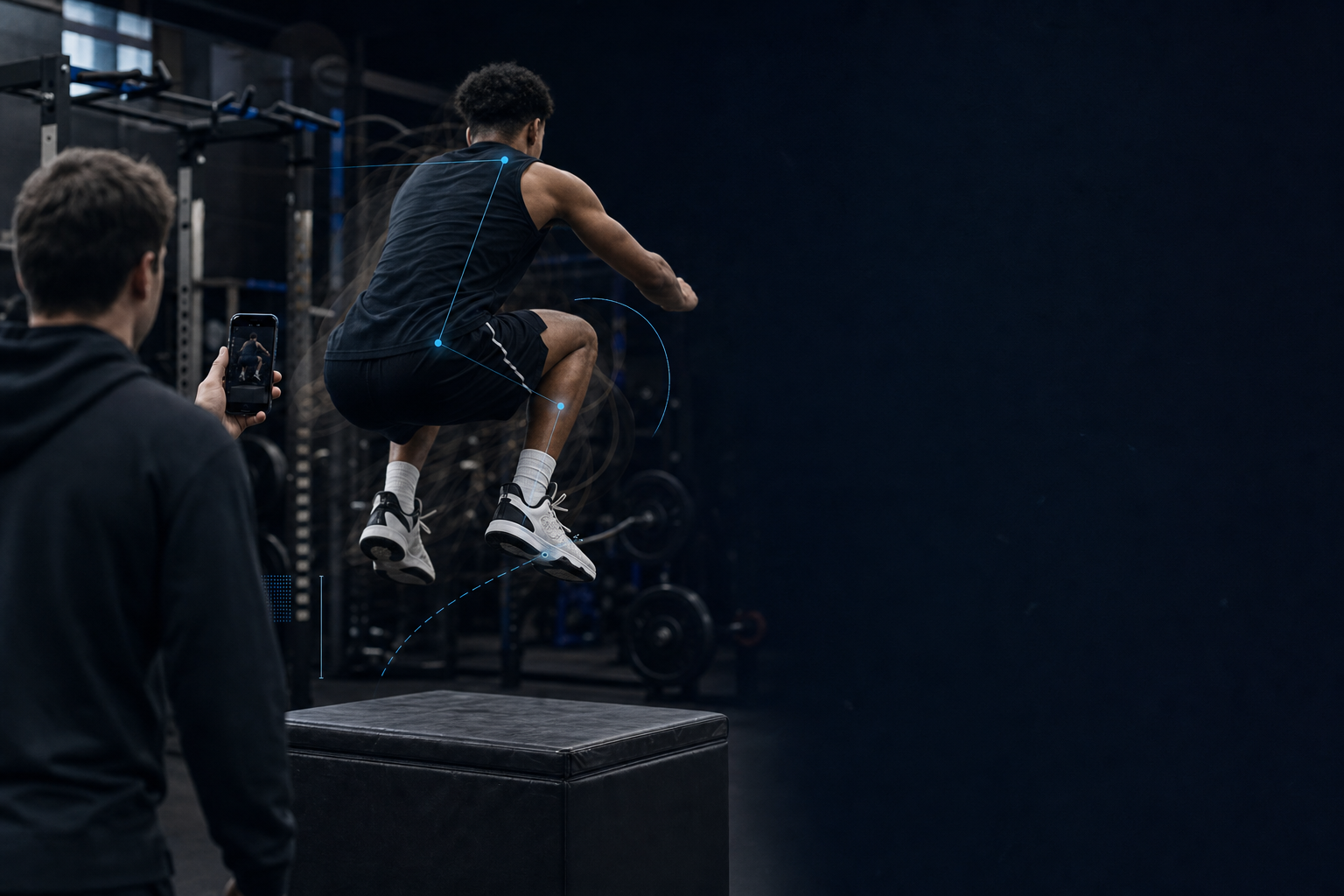
A simple habit makes this layer far more effective: film it. A front-on phone video of a snap-down or drop landing shows what the eye misses in real time, especially knees caving inward or stiff, straight-leg landings. Reviewing that footage weekly, or letting Greater's AI movement analysis flag risky landing patterns automatically, turns guesswork into coaching.
How to progress, and when to back off
Progression is boring on purpose. When an athlete completes every set of a main lift with good form, add roughly 2 to 5 pounds for upper-body lifts or 5 to 10 pounds for lower-body lifts the next week. If form breaks, the weight stays put. That is the whole system.
Back off when the signals say to. Form breakdown that does not fix with a cue, joint pain rather than muscle fatigue, or an athlete running on poor sleep during exam weeks. Cut the load, not the movement. Any pain that is sharp, persistent, or swelling-related is a stop sign: see a physician or physical therapist before continuing.
Three mistakes show up in almost every self-run offseason. First, skipping the deload weeks because progress feels good. The lighter weeks are where the body actually adapts, and weeks 5 to 7 will be better for it. Second, turning Day C jumps into a conditioning session. Jump quality drops fast with fatigue, and tired jumping trains bad landings. Keep the reps low and the intent maximal. Third, adding extra exercises. More is not the program. If an athlete has energy left to add curls, the main lifts were too light.
What happens after week 8
Strength is kept, not stored. The good news is that keeping it is cheap. A systematic review of in-season training frequency found that roughly one quality resistance session per week can maintain strength through a competitive season. One 30 to 40 minute session fits any basketball schedule.
| Exercise | Sets x reps | Notes |
|---|---|---|
| Back squat or trap bar deadlift | 3 x 5 | Moderate load, crisp speed |
| Bench press or push-up | 3 x 6 | Leave two reps in reserve |
| One-arm dumbbell row | 3 x 8 per arm | Smooth and controlled |
| Snap-down to stick | 2 x 5 | Keep landing quality sharp all season |
Schedule it on the lightest practice day, never the day before a game. Athletes who keep this single session tend to start the next offseason ahead of where they finished the last one. Athletes who want to push further into pure strength once the season is over have a natural next step in how to start powerlifting.
Running this program with a team
The program is the easy part. The hard part is operational: getting twelve athletes the right session on the right day, knowing who actually did the work, and spotting the athlete whose landings look risky before it becomes a problem.
That workflow is what Greater is built for. Coaches assign the program once, athletes get each session on their phone, completion is tracked automatically, and messaging lives in the same place. Athletes can film their landing and lifting work, and Greater's AI movement analysis reviews it between sessions. This is how schools and athletic programs run team training in Greater. Trainers and coaches still choosing a platform can start with our breakdown of Trainerize alternatives.
Run this program with your team
Assign all 8 weeks in minutes, track completion, and let AI movement analysis watch the landings.
Try Greater freeVertical jump is one of the easiest numbers to retest from this program. For a dedicated plan built around jump testing, see our vertical jump program guide.
Frequently asked questions
How many days a week should basketball players lift in the offseason?
Three days per week is the sweet spot for most high school and club players. It leaves room for skill work, pickup games, and recovery. Two days still produces progress if scheduling is tight. Every session in this program assumes at least one rest day between lifts.
Can middle school athletes run this program?
Yes, with adjustments. Keep the same structure but use lighter loads, prioritize technique over weight on every lift, and keep an adult supervising each session. The international consensus on youth resistance training supports supervised lifting for this age group. When in doubt, goblet squats and dumbbells beat barbells.
Should players keep playing basketball during the 8 weeks?
Yes. Skill work and games keep the training relevant. Just manage total jump volume. If a week is heavy on pickup games or camps, trim the jump exercises from Day C rather than stacking more landings on tired legs.
What if we only have 6 weeks before the season?
Compress each phase to three weeks. Keep week 3 slightly lighter as a mini deload and use the final few days before the season to taper. Do not skip the landing work to save time. It is the most basketball-specific part of the program.
Will players lose their gains once the season starts?
Not if they keep lifting a little. Roughly one quality strength session per week maintains most strength through a season. The in-season maintenance table in this article is designed for exactly that.