

Soccer Strength Training Program: The 8-Week Offseason Block
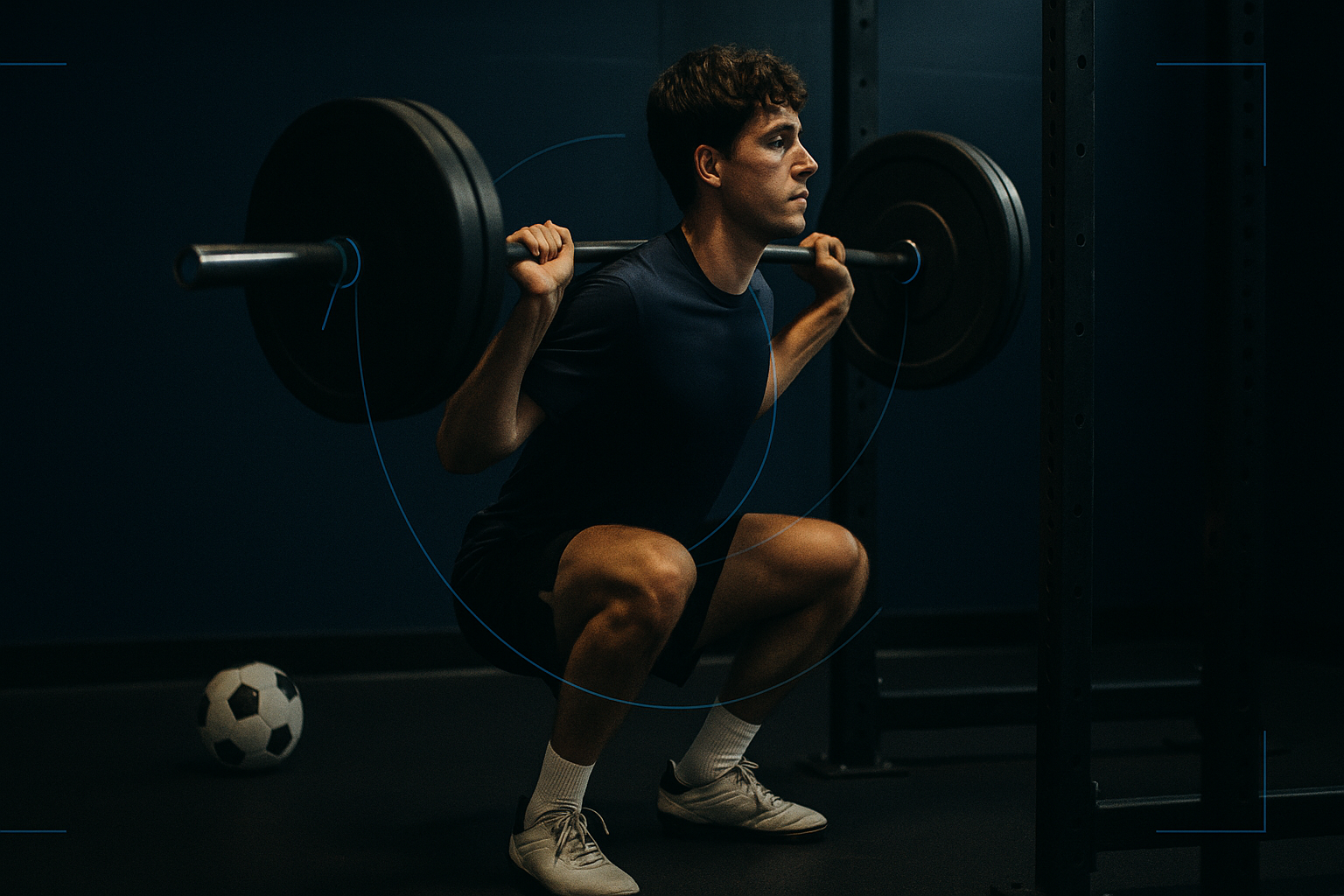
Most soccer strength training programs are a list of exercises. That is the easy part. The hard part is the dose. How many days a week, for how many weeks, at what intensity, and what it costs you to skip it.
This is the dose. Two lifting days a week for eight weeks, built for the offseason, aimed at the part of the match that actually hurts people.
The program in one screen
A soccer strength training program is two gym sessions a week that build lower-body force, protect the hamstrings, and keep a small amount of jumping and sprinting in the legs. Intensity climbs across the block. Volume comes down. Eight weeks is enough to change how hard an athlete can push into the ground.
Here is the whole thing.
| Week | Focus | Day A main lift | Day B main lift | Intensity target | Jump or sprint exposure |
|---|---|---|---|---|---|
| 1 | Build tolerance | Back squat 4 x 6 | Split squat 3 x 8 each side | RPE 7 | 3 x 4 countermovement jumps |
| 2 | Build tolerance | Back squat 4 x 6 | Split squat 3 x 8 each side | RPE 7.5 | 3 x 4 countermovement jumps |
| 3 | Add load | Back squat 4 x 5 | Split squat 3 x 8 each side | RPE 8 | 3 x 4 broad jumps |
| 4 | Add load | Back squat 5 x 4 | Split squat 3 x 6 each side | RPE 8 | 3 x 4 broad jumps, 4 x 20 m accelerations |
| 5 | Deload, not optional | Back squat 3 x 4 | Split squat 2 x 6 each side | RPE 6 | Jumps only, no sprints |
| 6 | Heaviest phase | Back squat 5 x 3 | Split squat 3 x 6 each side | RPE 8.5 | 5 x 20 m sprints |
| 7 | Heaviest phase | Back squat 4 x 3 | Split squat 3 x 5 each side | RPE 9 | 6 x 20 m or 4 x 30 m sprints |
| 8 | Taper into preseason | Back squat 3 x 3 | Split squat 2 x 5 each side | RPE 8 | 4 x 20 m sprints at full speed |
Day A is the heavy bilateral day. Day B is the single-leg and hamstring day. Both days finish in under an hour. Neither day needs a facility.
What a soccer match actually asks for
A soccer match is mostly sub-maximal running interrupted by a handful of sprints. The sprints are the part the gym work is for.
Across three seasons of Major League Soccer tracking data, players who completed 85 minutes or more covered about 9,950 metres per match. Of that, roughly 519 metres came at high speed and 166 metres at a true sprint. The average player produced about ten sprint efforts in a match.
Read those numbers again. Ten sprints. Under 200 metres of the 10 kilometres is spent at full speed.
That is why conditioning alone does not cover it. The aerobic base gets you through 90 minutes. The ten sprints, the decelerations into them, and the cuts out of them are a force problem. Force is what a barbell trains.
Position changes the picture. In the same data set, full-backs and wide midfielders covered the most high-speed and sprint distance, around 599 and 225 metres. Central midfielders covered the most total ground, over 10,500 metres, but sprinted less. The wide players are doing the most high-velocity work, so they are the ones whose hamstrings and sprint exposure need the most attention.
Why the offseason is the window
The offseason is the only block in the year when you can add strength without a match on Saturday. It is also the block where fitness quietly leaves.
A meta-analysis of twelve studies in male soccer players measured both sides of that. Players who stopped training entirely lost aerobic power with a large effect size of -1.48, lost vertical jump at -0.81, and got worse at repeated sprinting. Players who ran an off-season training programme lost less: -0.48 for aerobic power, -0.51 for jump.
Two things in that are worth sitting with.
First, doing nothing costs substantially more aerobic power than running a programme, and that difference was statistically significant.
Second, the programme group still lost ground. A structured offseason does not hold everything. What it does is arrive at preseason with a smaller hole to climb out of, and with more strength than you had in May.
That study reports standardised effect sizes rather than raw percentages, so treat the sizes as direction and magnitude, not as a precise forecast for one athlete.
What strength work does to injury risk
Strength training is the single best-evidenced training intervention for reducing sports injury risk. That is a strong claim and it holds up.
Pooling 25 randomised trials across 26,610 participants, strength training cut sports injuries to under a third of control rates, a risk ratio of 0.315. In the same analysis, stretching did nothing measurable, with a risk ratio of 0.963.
A later pooled analysis of six trials found the same direction and added a dose relationship: a 10 percent increase in strength training volume reduced injury risk by more than four percentage points, with an overall risk ratio of 0.338. That dose figure comes from a post-hoc analysis, so it is a strong hint rather than a settled number.
A structured warm-up matters alongside the lifting. In a cluster-randomised trial across NCAA men's soccer teams, the teams running a standardised neuromuscular warm-up recorded 8.09 injuries per 1000 athlete-exposures against 15.04 in the control teams, a 46.1 percent lower injury rate and 28.6 percent less time lost.
None of this prevents injury. Soccer involves other people running at you. What the evidence supports is a meaningful reduction in risk, and it supports strength work more clearly than it supports anything else on offer.
The honest version of the hamstring question
Eccentric hamstring work is the most-discussed exercise in soccer injury prevention, and the evidence is genuinely contested.
The soccer-specific pooled analysis found that prevention programmes including the Nordic hamstring exercise roughly halved hamstring injury rates, an injury rate ratio of 0.490. That is the figure you see quoted everywhere.
Then a methodological reappraisal re-examined the larger pooled dataset and found that only five of the fifteen included studies had actually randomised athletes to the exercise. Re-running the analysis on those five gave a risk ratio of 0.56 with a confidence interval from 0.20 to 1.52. The interval crosses 1, which means the effect was no longer statistically significant.
So the honest summary is this. The point estimate consistently favours eccentric hamstring work, somewhere around a 40 to 50 percent reduction. The confidence in that number is weaker than the headlines suggest. It is cheap, it takes three minutes, and the downside is soreness. Run it, and do not promise anyone it is a guarantee.
Hamstrings are the position-specific risk in this sport, and why they go in soccer specifically is worth understanding before you program around them. If an athlete is coming back from a hamstring strain, that is a rehabilitation question and it belongs with a physical therapist, not with this program.
The lifts that transfer, and why
The gym work earns its place by changing how much force goes into the ground, which is the thing sprinting and jumping are made of.
In a study of 17 international-level male players, half-squat maximal strength tracked closely with 10 metre sprint time and vertical jump height, with correlations of 0.94 and 0.78. Seventeen players is a small sample and a correlation is not proof that lifting causes the sprint, so do not over-read the exact numbers.
Five slots do the work. Everything else is optional.
- A heavy bilateral lift. Back squat or trap-bar deadlift. This is the strength driver. It is the slot where the load actually climbs.
- A hip hinge. Romanian deadlift or hip thrust. Posterior chain force at long muscle lengths, which is where sprinting lives.
- A single-leg pattern. Split squat, step-up or single-leg RDL. Soccer is played on one leg at a time. Bilateral strength does not automatically show up on one foot.
- Eccentric hamstring work. Nordic curl, or a regression of it. Three minutes, twice a week.
- A jump or sprint exposure. Short, sharp, early in the session. This is what keeps the nervous system in the habit of producing force fast, so the strength you build has somewhere to go.
If you want the one-session version of this rather than a whole block, the soccer leg workout covers the same five slots in a single sitting.
Without a barbell: goblet squat or heavy kettlebell deadlift for slot one, single-leg RDL with dumbbells for slot two, rear-foot-elevated split squat for slot three, a partner-held or band-assisted Nordic for slot four, and broad jumps or 20 metre accelerations for slot five.
The 8-week block, week by week
The structure is simple. Weeks 1 and 2 build tolerance. Weeks 3 and 4 add load. Week 5 backs off. Weeks 6 and 7 are the heaviest. Week 8 drops volume and keeps the sharpness so the athlete arrives at preseason fresh.
Intensity climbs while volume falls. That is the same logic as block periodization, applied over a short runway.
Use RPE if you do not have tested maxes. RPE 7 means roughly three reps left in the tank. RPE 8 means two. Nobody should see RPE 10 in an offseason block.
Week 1. Day A: back squat 4 x 6 at RPE 7. Day B: single-leg work 3 x 8 each side at RPE 7. Nordic curl 2 x 4. Jump exposure: 3 x 4 countermovement jumps.
Week 2. Same structure, add a small amount of load. Day A: 4 x 6 at RPE 7.5. Nordic curl 2 x 5.
Week 3. Day A: back squat 4 x 5 at RPE 8. Day B: single-leg 3 x 8 at RPE 8. Nordic curl 3 x 5. Jump exposure: 3 x 4 broad jumps.
Week 4. Day A: 5 x 4 at RPE 8. Day B: single-leg 3 x 6 at RPE 8. Nordic curl 3 x 5. Add 20 metre accelerations, 4 reps, full recovery.
Week 5. Deload. Cut sets roughly in half and drop to RPE 6. Day A: 3 x 4. Day B: 2 x 6. Nordic curl 2 x 4. Keep the jumps, drop the sprints. This week is not optional. It is what makes weeks 6 and 7 possible.
Week 6. Day A: back squat 5 x 3 at RPE 8.5. Day B: single-leg 3 x 6 at RPE 8. Nordic curl 3 x 6. Sprints: 5 x 20 metres.
Week 7. The heaviest week. Day A: 4 x 3 at RPE 9. Day B: single-leg 3 x 5. Nordic curl 3 x 6. Sprints: 6 x 20 metres, or 4 x 30 metres.
Week 8. Taper. Volume drops by about half, intensity stays high. Day A: 3 x 3 at RPE 8. Day B: 2 x 5. Nordic curl 2 x 5. Sprints: 4 x 20 metres at full speed. The athlete should leave this week feeling fast, not flattened.
Day A and Day B, exercise by exercise
Day A, the heavy day, about 50 minutes
- Warm-up: 8 minutes. Easy bike or jog, then ankle, hip and groin work, then two sets of bodyweight squats and glute bridges.
- Jump or sprint exposure per the week above. Full recovery between reps. Quality only.
- Back squat or trap-bar deadlift. Sets and reps per the week. Rest 3 minutes between sets.
- Romanian deadlift, 3 x 8. Slow on the way down. Load is secondary to the stretch under tension.
- Horizontal push or pull, 3 x 8. Bench press, dumbbell row, or both. Soccer players need an upper body for duels and for staying square.
- Trunk: dead bug or Copenhagen plank, 3 sets. The Copenhagen is worth the discomfort for groin resilience.
Day B, the single-leg and hamstring day, about 45 minutes
- Warm-up: same 8 minutes.
- Change-of-direction work: 6 cone cuts at three-quarter speed each side. Speed only goes up when the planting foot stays stable.
- Single-leg strength. Rear-foot-elevated split squat or step-up. Sets and reps per the week. Each side.
- Nordic hamstring curl per the week. If a full rep is not available, use a band, a partner, or a shortened range and work up. Progression matters more than the number of reps.
- Single-leg RDL, 3 x 8 each side. Light. This is a control exercise, not a loading exercise.
- Calf and foot work, 3 x 12 heel raises, slow on the lowering phase. Ankles take a beating in soccer.
- Trunk: side plank with a leg lift, 3 sets each side.
Two sessions a week is the floor that works and the ceiling most offseason athletes will actually hit. A third day helps if the athlete is already consistent with two. Nobody should add a third day before they have finished eight weeks of two.
How to run it on the field, not on paper
The dose only works if it gets done. That is the whole problem with offseason programming. The athlete is not in front of you, the program lives in a PDF on their phone, and by week 3 you have no idea who is still doing it.
The evidence base is built on trials where compliance was tracked, usually by self-report. The reduction in injury rate in the collegiate warm-up trial came from teams that ran the program consistently through a season. A program nobody finishes has no effect size.
Three things make it stick.
- Attach it to something. The lifting days go next to days the athlete is already training or already at a gym. A session that requires a new trip rarely survives week 4.
- Make the progression automatic. The athlete should not have to decide what today's load is. The week's prescription answers it.
- Know who finished. Not who said they would. Who logged the session.
That last one is the part that breaks down over a summer. Greater lets you assign the block, see which athletes completed each session, and adjust the next week based on what actually happened rather than what was planned. Try it with a squad.
Adjusting the block
By position
Full-backs and wide midfielders do the most sprinting and the most high-speed running, so they get the full sprint exposure and the full hamstring volume. Centre-backs and central midfielders can run the same lifting, with sprint volume toward the lower end of each week's range. Goalkeepers want more in the way of lateral work, jumping and trunk work, and less straight-line sprinting.
For youth players
Yes, a 12 year old can do strength and conditioning for soccer. A review of the injury evidence in young lifters concluded that supervised resistance training is relatively safe and effective for children and adolescents, with qualified instruction and age-appropriate technique as the conditions. The injuries that do appear in the literature cluster around poor technique, inappropriate loads, and missing supervision. What changes is the emphasis. Technique before load, bodyweight and light implements before barbells, and a coach watching. Jumping and landing practice is high value at that age. Chasing a one-rep max is not. Growth and maturation vary enormously between two 12 year olds, so the decision is individual and worth running past a qualified coach or a physician.
For another sport
The same structure works with the sprint exposure swapped out. The 8-week offseason basketball block is the jumping-heavy version of this idea.
For a short offseason
With four to six weeks, cut the block rather than compressing it. Run weeks 1, 3, 6 and 8 as a four-week version. Keep the deload if you have six weeks, drop it if you have four. The one thing not to do is run weeks 6 and 7 intensities in week 1.
Coming back from injury
If an athlete is returning from a hamstring strain, an ACL reconstruction, or any injury still under care, this block is not the starting point. Return to sport belongs to the treating physical therapist or physician, and the criteria they use are more specific than anything a general program can carry. The block is what the athlete grows into afterwards, not what they come back on.
Assign the block, then see who actually ran it
Give every athlete the eight weeks, track which sessions got completed over the summer, and adjust next week from what happened instead of what was planned.
Try GreaterFrequently asked questions
Do soccer players need strength training?
Yes. A soccer match is built on roughly ten maximal sprints and the decelerations and cuts around them, which are force demands rather than aerobic ones. Strength training also has the strongest evidence of any training intervention for reducing sports injury risk. Pooling 25 randomised trials, it cut injuries to under a third of control rates.
How many days a week should a soccer player lift?
Two is the number that works and the number most offseason athletes will actually complete. Each session runs 45 to 50 minutes. A third day is worth adding only once the athlete has finished a full eight-week block at two days a week.
Will lifting make a soccer player slower or heavier?
Not at the volumes in an offseason block. Maximal lower-body strength tracks closely with 10 metre sprint time and vertical jump height in elite players, which is the opposite of the fear. Weight gain comes from eating for size, not from two sessions a week aimed at force production.
Should a 12 year old do strength and conditioning for soccer?
Yes, with supervision. A review of youth resistance training injuries concluded it can be relatively safe and effective for children and adolescents provided qualified professionals supervise sessions and teach proper technique, with the emphasis on technique, bodyweight and light loads rather than maximal lifting. Jumping and landing quality is the highest-value work at that age. Because maturation varies so much between individuals, the specifics are worth discussing with a qualified coach or a physician.
How long until strength work shows up on the field?
Eight weeks of consistent work is enough to move strength and jump measurably. Transfer to match sprinting is slower and depends on keeping some sprinting in the program the whole way through, which is why there is a jump or sprint exposure in every week of this block.
What if the offseason is only four weeks?
Cut the block, do not compress it. Run weeks 1, 3, 6 and 8 at their prescribed intensities. Starting a short block at week 6 or 7 loads is how offseasons end in a strain.