

How to Tone Arms for Women
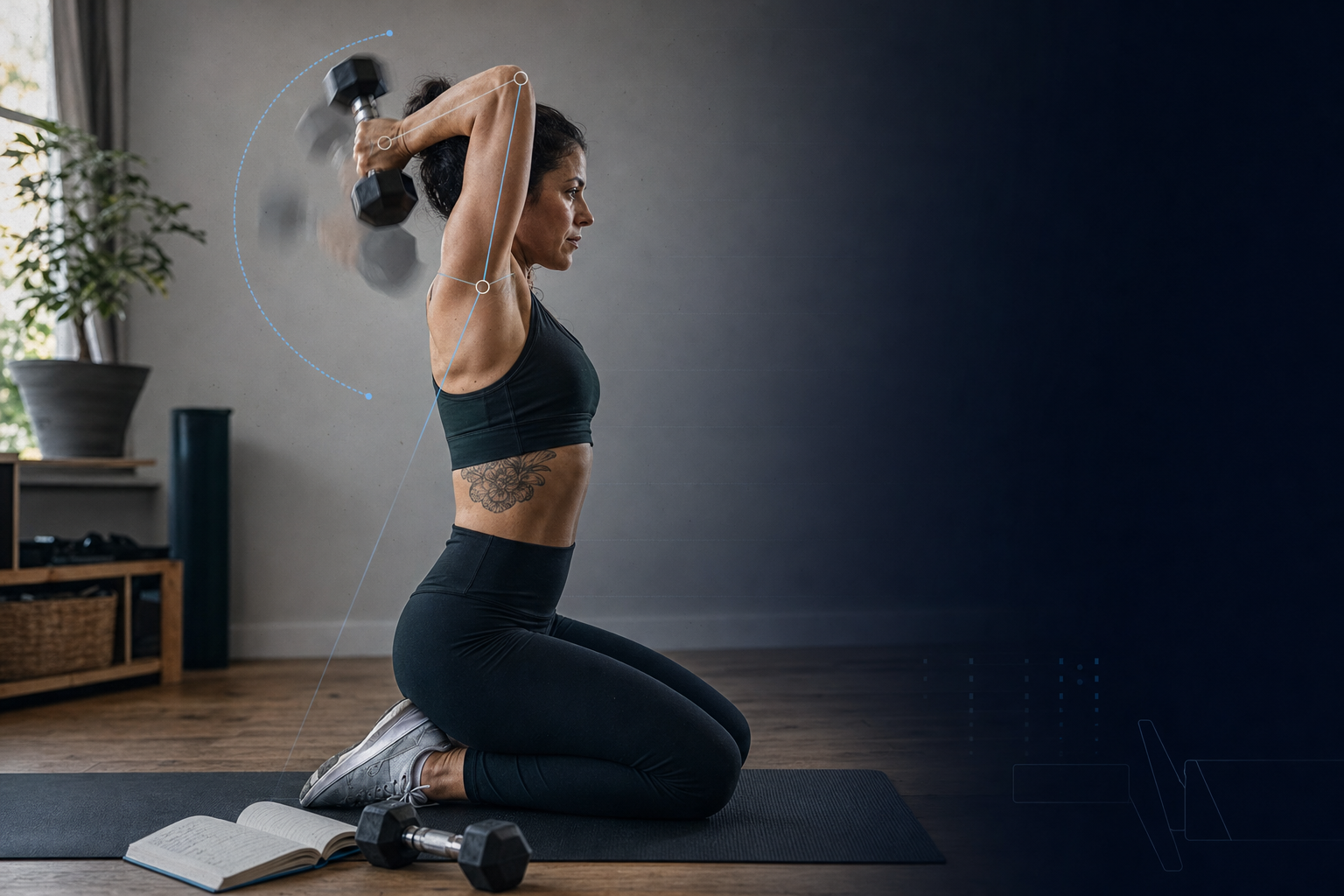
There is a story going around about women in New York paying five figures for what the coverage calls trophy arms. Procedures, peptides, trainers on retainer.
Muscle is not a luxury good. It is the single most available training adaptation there is.
What follows is what toning actually means, the one myth worth dropping before you start, and a complete eight-week program you can run with a pair of dumbbells at home or in a gym.
The short answer
Toning is two things happening at the same time. You build muscle, so there is shape to see. You lower body fat, so you can see it. Nothing else is going on.
The part most people get wrong is the second half. You do not get to choose where fat comes off. Training arms harder does not pull fat off arms specifically, and that is not an opinion. It has been tested directly and pooled across thirteen studies.
So the practical answer is: two arm-focused sessions a week, loads heavy enough that you stop two or three reps short of failure, progressed deliberately over eight weeks. The full program is below, with home and gym options for every movement.
Drop the bulking myth first
Almost every article on this topic tells women to use light weights and high reps so they tone without bulking up. It is the most repeated piece of advice in the category. It is also wrong, and it is the reason a lot of people train for a year without much changing.
Muscle grows across a wide spectrum of loads. In the research, 40, 60 and 80 percent of a one-rep max produced similar growth in both the upper and lower body. There is no special light-weight zone that produces shape instead of muscle.
There is a floor, though. In that same work, training at around 20 percent of a one-rep max produced roughly half the growth of the heavier conditions. Very light weights for very high reps are not a shortcut. They are a slower route to the same place.
A large pooled analysis of resistance training prescriptions reached the same conclusion from a different direction. All prescriptions comparably promoted muscle growth. Heavier loads were what maximized strength.
Here is the part worth sitting with. Tone is not a different tissue from muscle. Tone is muscle. When you say you want toned arms, you are saying you want more muscle and less fat covering it. Once that is clear, the training gets much simpler, because you are no longer trying to do a thing that does not exist.
Nobody accidentally builds large arms. Muscle that is visible from across a room is the result of sustained, deliberate work. The women whose arms get written about trained for them on purpose.
The other reason light-and-easy fails is that it never changes. A program that stays the same stops working, which is why training is organized into blocks that progress.
Where the fat actually comes off
Researchers pooled thirty-seven comparisons from thirteen studies covering 1,158 people. In each one, participants trained one limb and left the other untrained. If training a body part removed fat from that body part, this is the design that would show it. The pooled effect was essentially zero, at -0.03, with low variation between studies and no sign of publication bias.
Spot reduction was not observed. Seventeen of the comparisons favored the trained limb, twenty favored the untrained one, which is what noise looks like.
That leaves two separate levers, and only one of them is in the gym.
- Arm training changes the muscle underneath. That is what the program below is for.
- Overall body composition changes how much sits on top of it. That is a nutrition and lifestyle conversation, and it is not specific to arms.
One honest limitation. This evidence compares a trained limb against the same person's untrained limb, so it tells you where fat comes off, not whether training works. Training works. It just does not take requests about location.
How much arm work you actually need
The number that matters most is weekly sets. Across sixty-seven studies and more than two thousand participants, growth increased as weekly volume increased, with clearly diminishing returns as the numbers climbed.
A separate review put the practical bracket at twelve to twenty weekly sets per muscle group. Treat that as a ceiling to build toward rather than a place to start, for two reasons.
First, that bracket came from a review of young, trained men. Second, the broader volume research has the same problem: the dose-response evidence base is about eighty percent male. That is worth saying out loud rather than quietly applying men's numbers to women and hoping.
What about training arms more often? Once weekly volume is matched, frequency does not have a pronounced effect on muscle growth. Training once a week produced similar results to twice or three times.
So two sessions a week is not a magic number. It is simply a practical way to fit the volume in without one punishing session. If three shorter sessions suit your week better, that works too, as long as the weekly sets land in the same place.
The eight-week program
Two sessions a week, eight weeks, with at least two days between them. Everything here can be done with a pair of adjustable dumbbells at home. Gym alternatives are listed with each movement. If you are working around an existing injury or anything hurts in a joint, read the note at the end of this article before you start.
Warm up before you start. Five minutes of easy movement, then one light set of about ten reps on the first exercise of the session. That set does not count toward the numbers below.
Work in a six to fifteen rep range. On every working set, stop when you think you have two or three good reps left. Lean toward three in weeks one and two, and toward two in the heaviest weeks. Not when it burns, and not when form breaks down.
Session A
- Dumbbell floor press or push-up, 3 sets of 8 to 12. In a gym: bench press or machine chest press. This is the compound that loads your triceps alongside the chest.
- One-arm dumbbell row, 3 sets of 8 to 12 per side. In a gym: cable row or chest-supported row. Loads the biceps alongside the back.
- Overhead dumbbell triceps extension, 3 sets of 10 to 15. Both hands on one dumbbell, elbows pointed forward, lower behind the head under control. In a gym: cable overhead extension with a rope.
- Dumbbell biceps curl, 3 sets of 10 to 15. Keep the elbow still. The upper arm should not swing.
- No dumbbells: a resistance band covers the row, the extension and the curl. For pressing, elevate your hands on a counter and progress toward the floor over the eight weeks.
Session B
- Dumbbell overhead press, 3 sets of 8 to 12. In a gym: barbell or machine shoulder press. Different angle on the triceps than Session A.
- Dumbbell pullover or lat pulldown, 3 sets of 10 to 12. At home, a pullover lying across a bench or sofa edge.
- Dumbbell triceps kickback or bench dip, 3 sets of 10 to 15. On dips, keep your hands close to your hips and stop before your shoulders roll forward. If the front of the shoulder complains, use the kickback instead. In a gym: cable pressdown.
- Hammer curl, 3 sets of 10 to 15. Palms facing each other. Hits a different part of the upper arm than a standard curl.
- Finisher from week three: one set of curls and one set of extensions taken close to failure. Keep it in from week three onward. The weekly set counts in the table below include it.
Picking your starting weight
This is the question nobody answers, so here is a method. Pick a dumbbell you think is too light. Do a set of twelve. If you finish and could clearly have done six or seven more, it is too light. Go up and try again after a couple of minutes.
You are looking for the weight where rep twelve is genuinely hard but your form has not changed. That is your week one working weight. Expect to get this wrong on at least two exercises, and expect to fix it in week two. Everyone does.
Triceps and biceps movements will use far lighter dumbbells than presses and rows. That is normal and not a sign of anything.
Make the reps count
Set and rep numbers get all the attention, but how you execute them decides what the work is worth. Four things matter more than the number on the dumbbell.
- Full range of motion. Lower the weight all the way and finish the rep completely. Shortening the range to use a heavier dumbbell trades the thing you came for against a number nobody sees.
- Control the lowering. Take about two seconds to lower and lift without throwing. Rushing turns a strength exercise into a momentum exercise.
- Keep the working joint still. On curls and extensions, the upper arm stays put and only the elbow moves. If your shoulder is swinging the weight up, your biceps are getting a lighter session than you think.
- Finish close enough to failure. Effort matters, and it matters more the lighter you go. A high level of effort is especially important with lighter loads. Two or three reps in reserve is the target, not twelve comfortable ones.
If you have to break one of these to lift the weight, the weight is too heavy for this week. It will not be too heavy for long.
How to progress
Use double progression, which is the simplest honest method there is. Stay with a weight until you can hit the top of the rep range on every set. Then add the smallest increment you have and drop back to the bottom of the range. Repeat.
Sets climb too, and that is the part most arm routines leave out. Run every exercise above for three sets in weeks one and two. Go to four sets in weeks three and four. Go to five sets from week six onward. That takes your direct triceps and biceps work from six sets per muscle per week to eleven, which is the ramp the table below describes.
From week six, take the first two lifts in each session down to six to ten reps and put the load up to match. The isolation work stays at ten to fifteen.
Write down what you lifted. Not for discipline, for information. The log is how you know whether the last three weeks did anything, and memory is a poor substitute.
Week five is a deload. Keep the same exercises, drop to two sets each, and leave four or five reps in reserve instead of two or three. Skip the finisher this week. You are not losing ground. You are letting fatigue clear so weeks six through eight can be productive.
The eight-week progression at a glance
| Weeks | Direct sets per muscle per week | Rep range | Effort | What changes |
|---|---|---|---|---|
| 1 to 2 | About 6 | 8 to 15 | 3 reps in reserve | Three sets per exercise. Learn the movements and find your starting loads. Nothing should feel desperate. |
| 3 to 4 | About 9 | 8 to 15 | 2 to 3 reps in reserve | Four sets per exercise. Add the finisher. Loads start climbing through double progression. |
| 5 | About 4 | 8 to 15 | 4 to 5 reps in reserve | Deload. Same exercises, two sets each, no finisher. |
| 6 to 7 | About 11 | 6 to 15 | 2 reps in reserve | Five sets per exercise. The compounds drop to 6 to 10 reps with heavier loads. |
| 8 | About 11 | 6 to 15 | 2 reps in reserve | Same sets, highest effort of the block. Then reassess and start again from week one with new loads. |
Those weekly set numbers climb toward the twelve to twenty set bracket described earlier. They stay under it on purpose. The ramp exists because volume drives growth with diminishing returns rather than endlessly. More is not automatically better.
If you want to understand how the week above was assembled, the same logic applies to building any weekly training structure.
What to eat, briefly
Protein is the part of nutrition that bears directly on this. Across forty-nine studies, additional protein improved gains in lean mass, strength and muscle fiber size during prolonged resistance training.
The figure usually quoted from that work is a breakpoint around 1.6 grams per kilogram of body weight per day. It deserves more honesty than it normally gets. The breakpoint was not statistically significant. The confidence interval ran from 1.03 all the way to 2.20. The authors themselves suggest about 2.2 grams per kilogram may be prudent for anyone trying to maximize gains.
Two more caveats. The size of the benefit was small, around 0.3 kilograms of lean mass. And the authors note plainly that far less of this research has been done in women than in men.
Practically: get protein into most of your meals and stop optimizing past that. This article is not going to give you a calorie target or a meal plan. If you want to change your body composition, that is a longer conversation and a registered dietitian is the right person for it.
How long this actually takes
No honest answer to this is a specific number of weeks, and anyone offering one is guessing. What can be said is better than a guess.
If you are new to lifting, you have the easiest conditions you will ever have. Untrained people achieve large gains in muscle without even training to failure. Training to failure appears to matter more once you are already trained.
On how women respond: across twenty-nine studies, relative increases in muscle size were similar between sexes. The same research found that absolute increases in upper-body muscle favored males, which is directly relevant here and worth knowing rather than being surprised by later.
The practical shape of eight weeks: the first thing that changes is how the work feels. Loads that were hard in week one are warm-ups by week six. Visible change lags behind that, usually by a good margin. It also arrives in a way that is hard to notice day to day, because you see yourself every day.
This is one block. Arms that look the way you want them to are the result of a lot of blocks in a row. That pattern is the same whatever the goal, and it shows up clearly in how experienced lifters structure their training over years rather than weeks.
Five ways this goes wrong
- Training arms every day. More frequency without more weekly volume adds fatigue and nothing else.
- Using the same weight for months. If the dumbbells have not changed since week one, neither has the stimulus.
- Chasing rep counts instead of controlling reps. Fifteen rushed reps with momentum are worth less than ten controlled ones.
- Expecting arm training to change arm fat. It changes the muscle. Those are different jobs.
- Quitting in week three. Week three is where the work has started and the mirror has not caught up. It is the most common place to stop and the worst one.
The bottom line
Train arms twice a week. Use a weight you could stop two or three reps short on, somewhere between six and fifteen reps. Add reps, then add load. Build from roughly six weekly sets per muscle toward eleven across eight weeks. Deload in week five. Write down what you did.
Nothing in that list costs twenty thousand dollars. It costs eight weeks and a pair of dumbbells. You also get to keep the strength.
If anything hurts in a joint, or you are working around an existing injury, see a physician or a physical therapist before pushing through it. No program is worth training into pain for.
Frequently asked questions
How long does it take to tone your arms?
There is no honest fixed answer, and anyone quoting a specific number of weeks is guessing. What the research supports is that people new to lifting make large gains in muscle readily, even without training to failure. In practice, over an eight-week block the first thing you notice is that the loads feel easier. Visible change lags behind that, and because you see yourself every day it is easy to miss while it is happening. The training log is the honest record.
Will lifting weights make my arms bulky?
No, not accidentally. Muscle that is visible from across a room is the result of sustained, deliberate training, not a side effect of a few months of dumbbell work. Light weights are not a way to avoid it either. Muscle grows similarly across roughly 40 to 80 percent of a one-rep max. The light-and-high-reps approach is not a different outcome, just a slower route to the same one.
Can you tone your arms without weights?
Yes, up to a point. Resistance bands, push-up variations and bench dips all provide real resistance, and growth happens across a wide range of loads. The limitation is progression. Once bodyweight movements stop being challenging, you need a way to keep adding difficulty, whether that is harder variations, slower tempo, or eventually some form of added load.
How often should women train arms?
Twice a week works well, with at least two days between sessions. The available evidence suggests that once total weekly sets are matched, how you split them across the week has no pronounced effect on muscle growth. So two sessions is about convenience rather than magic. Three shorter sessions are equally fine if the weekly volume ends up in the same place.
Why are my arms not toning even though I work out?
Usually one of three things. The load has not changed in months, so there is no reason for the muscle to adapt. The weekly set count is too low to drive much growth. Or the expectation is that arm training will remove arm fat, which it does not do. Training changes the muscle underneath; overall body composition determines how much covers it.
What does toned actually mean?
Toned is not a separate tissue or a special kind of muscle. It describes having enough muscle to give the arm shape, with a low enough layer of body fat that the shape is visible. That is why the training answer is simply to build muscle, and why no particular weight or rep range produces tone rather than muscle.